(I’m not sure how to tell this one briefly, or with much humor. Sorry about that. It’s just not a brief or funny story.)
In my twenty-some years on the World Wide Web I’ve read many, many tales of woe. People reach the end of their rope and appeal for help, and I don’t blame them for that: it’s just that I’m not sure it does any good. Not in the long term, anyway.
There’s probably a brief period when folks chip in whatever they can. But I’m always left wondering what the long term effect is, once you expose your vulnerable underbelly and admit that you just can’t make it on your own. Doesn’t that change the way people think about you? In a bad way, I mean? And, once they’ve helped, don’t they expect you to just be okay now?
This may be testosterone talking. But the result is that even though I have a Tale of Woe I’ve always kept it to myself.
That’s changed today. I can’t afford to care what you think any more.
It all started so well
I left the games business earlier than I planned, back in 2005, because I simply couldn’t face another project. The games business really is a place for the young, and it could be I’d had a bad run of luck; but whatever the cause I was just too burned out to keep going on that treadmill of bizarre decisions and endless crunch time and, in my case, plenty of responsibility without any authority at all.
I had an exit strategy: to find an inexpensive home where I could live and build up my online business and pursue only those projects that no one but me was likely to create. This is a pretty good description of what I thought I was here for, but which I’d found so hard to do while working for other people.
So I bought a fixer-upper of a house and started to fix it up; not quickly, but steadily, since I was building up my business at the same time.
It wasn’t easy. But it worked! By 2008 it seemed like everyone on the web was linking to my Retropolis Transit Authority T-shirts and man, oh man, were they selling, that summer!
The thing I laugh about now is that I remember thinking that pretty soon I’d be able to afford health insurance.
I have a dark sense of humor, you see
Soon after I had that thought, I discovered that I had cancer.
The surprise was that it wasn’t lung cancer. I’d been a smoker for many years. But this was one of the other cancers, one that grows slowly, way down in your guts. You don’t find out about it for a long time.
Apparently you don’t find out about it until you start thinking about health insurance.
I seriously considered foregoing treatment. I really did. Though things were looking up, I couldn’t possibly afford the cost of my care. And I still argue with myself about whether that would have been a better choice.
Anyway, I was talked into treatment by medical professionals. The idea was that if I couldn’t afford it, there would be financial aid for me. And to some extent this was true.
But remember how business was looking up that year? It was, and in addition I had set aside the money for my income taxes. This is a thing that the self-employed do. And so, at the time I became sick, I was not indigent. I just didn’t have enough money to cover the costs of the tests, radiation, surgery, and post-surgical care.
We beat the cancer, which was great. (It’s still gone.) But first the bills wiped me out, and then they kept on coming.
The cost of beating cancer
Even at this length I can’t describe to you the full horror of what it’s like to deal with the US health care system when you don’t have insurance. That’s a story in itself.
But in the end, late in 2009, I finally had a single medical debt on which I could make monthly payments. And I kept making those payments until just a few months ago.
I’d been wiped out by the just the first few months of bills. Since I was still uninsured, I now had to meet other monthly expenses as a result of my surgery. My income rose and fell, but those costs were consistent, and I always met them. That meant acquiring other debts along the way.
Obviously, I wasn’t fixing up the house any more. (You can tell).
For nine years I’ve been staying ahead of it all with some success. I even wiped out my non-medical debts once or twice.
But during those years my income has also been dwindling. There have been brief reversals, like the Pulp-O-Mizer’s fifteen minutes of fame, or the book advances for Slaves of the Switchboard of Doom. Still the trend has always been down, in a month-to-month,white-knuckled race toward the date when I’d qualify for Social Security.
This year I lost the race.
This is why I’ve been quiet
Some of you noticed that I withdrew from the web once Patently Absurd was published. There was nothing I could say that wasn’t horrible, and of course I was trying one thing after another to turn things around.
It was rude of me to avoid responding to those of you who contacted me. But it seemed like the alternative was worse. I didn’t want to lie, but neither did I want to tell you the truth: so I’ve been saying nothing at all. That’s probably worried some of you, and I’m sorry.
As the year’s progressed I’ve defaulted on one bill after another. I’ve finally reached the twin hurdles of my property tax and my mortgage payment.
It seems certain that I’ll lose the house. I will likely try to sell it; but I don’t think I’d even get my equity back. And as for what I’ll do when I don’t have a house, that’s another difficult question. My mortgage payment is actually lower than any rent I might pay. So, yeah, there’s that.
I have to say… for a guy who’s worked on a hopeful future for the last twenty years I don’t seem to have any hope left for myself.
What does this all mean?
You can’t fix my problems. I don’t expect you to.
But this is still the best of all possible times for you to buy original art (especially!), merchandise from Retropolis and The Celtic Art Works, or copies of Patently Absurd.
I guess my hope is that if I manage to make it through the next few months, and I sell my house and most everything else, I’ll find some way to scale back and survive for a couple of years longer. The first tier of Social Security may not be much, but it’s a lot more than I have coming in now. That lowest tier is still two long years away.
So… this has been my Tale of Woe. I’m sorry I had to share it with you.
This entry was posted on Friday, July 27th, 2018
and was filed under Can't Stop Thinking, Thrilling Tales of the Downright Unusual
There have been 10 Responses »
If you’ve ever converted an ePub file to a .mobi file while making an eBook, you’ve probably noticed that your .mobi file is easily twice the size of the original ePub. The reason is that the Amazon tools for building .mobi files put more than one version in that single file.
This doesn’t matter, if the only place you’re selling the .mobi format book is on Amazon. That’s because when you upload your .mobi to Amazon they store it in more than one format: then when someone buys the book, the correct format for their device is sent to them.
So when Amazon delivers your book it will be roughly the same size file as the original ePub.
But what if you’re making the Kindle version available through your own web site? Your users are going to be saddled with a large file – maybe a huge file – because that’s what Amazon’s tools build. This may not matter so much for a book that’s all text, plus its cover; but it does matter. And if you build an illustrated book? Then it can matter a whole lot.
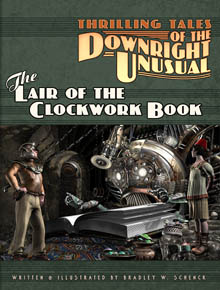 I’ve been working on an eBook edition of The Lair of the Clockwork Book. This is a book that has over one hundred and twenty illustrations; even when I convert them to greyscale the ePub ends up at around twelve megabytes. So the Kindle version built by the Kindle Previewer program is about twenty-four megabytes. If I make that book available for download from my own web site, we’re looking at a gigantic file.
For the past few years I’ve been formatting eBooks for Matthew Hughes. Over that time I’ve looked into the problem of .mobi file sizes more than once. The problem is that Kindlegen (the engine that does the actual conversion for Kindle Previewer) isn’t documented very well; and when you do a Google search for solutions to the problem you end up with a lot of results that aren’t helpful at all. Most of these turn out to be from Calibre users.
Calibre’s a very popular end-user tool for converting and editing eBooks. It’s never been any use to me, because once it gets its claws on an eBook it trashes the original CSS. That’s something that doesn’t seem to trouble its users, but it certainly troubles me. So although I’ve tried using a couple of Calibre plug-ins for working with .mobi files, the results haven’t ever been usable.

But this merely irritating problem with the .mobi file size became a real, terrible problem for The Lair of the Clockwork Book. So I had to look farther, and try harder, to find a real solution. And I finally found it here.
That article describes an obscure command line argument for Kindlegen that produces a simple, one format .mobi file. This .mobi file is about the same size as the original ePub (actually a little smaller, in my case). There’s a possible wrinkle here if you also want to provide an .azw3 version for Kindle users; I’ll address that at the end.
I was thrilled to discover that this works. But it was pretty complicated to use. This was partly because it’s been years since I spent much time in an MSDOS command console, but entering modern Windows paths, using quotation marks where there are spaces in directory names, was just so cumbersome that I figured there had to be a better way. There is!
You can write a .bat file to perform this conversion for you. So in order to make a stripped-down, single format .mobi file for the Kindle or Kobo readers, you just drag your ePub file’s icon onto the icon for the batch file.
The only tricky thing here is that you may need to edit the path to kindlegen.exe, which could be different from the one I’m showing below; and if any of the directories in the path use spaces you’ll have to use quotation marks around them, as you see in the example.
So start up any text editor – Notepad is fine – and begin by pasting this line into a blank document:
C:\"Program Files (x86)"\"Kindle Previewer"\lib\kindlegen.exe -dont_append_source %*
Here I’m assuming that your copy of kindlegen.exe was installed when you installed the Windows version of Kindle Previewer, and that you installed it on your C: disk. If you’ve installed Kindlegen someplace else, you’ll need to edit the path to Kindlegen. Notice how directory names like “Kindle Previewer” are surrounded by quotes. So in your own file you should edit the path to Kindlegen as needed.
Save this file with a .bat extension. I called mine makekindle.bat, but you can call it anything you like. Save the file someplace you’ll remember.
Now you can build your own smaller .mobi files just by dragging an ePub file onto the .bat file’s icon. (Even if there are spaces in the ePub’s file name!) The new .mobi file will be saved wherever the ePub file is.
Note this, though: the error report for the conversion will disappear in an instant. You should always build a file first with Kindle Previewer, just because that’s the only way you’ll see a list of the errors Kindlegen may have encountered.
Now we’re at the end, so it’s time for me to tell you how to get an .azw3 version if you also want one of those.
This is really easy if you have a Kindle: take the big fat .mobi file that Kindle Previewer made for you and email it to your Kindle. (If you’ve never done this, your Kindle has an email address. You can find it in your Amazon account pages.) When Amazon delivers the file to you, it will have been converted to whatever kind of file your Kindle supports. If your Kindle is anything like recent that will be an .azw3 file. Now connect your Kindle to your computer with a USB cable, then open the Documents folder and find the version Amazon sent you. Copy that to your computer.
There you go. Now you can offer your readers both .mobi and .azw3 files for their Kindles, from your own web site, and those files won’t be any bigger than they need to be.
This entry was posted on Wednesday, March 15th, 2017
and was filed under Can't Stop Thinking, Works in Progress
There have been no responses »
One of the questions we’ve faced since the election has been “Yeah, but what can I do?”
That’s an especially hard question for me, because what I do is pretty frivolous. No, wait: no false modesty today. What I do is just about as ridiculous and farcical as anything I can imagine, because imagining ridiculous and farcical things is exactly what I do.
What I do is almost as frivolous as sewing little tutus for Pomeranians. It’s pretty close.
So here’s where Rusty offered to help me out.
For a little robot who never speaks, the guy has a lot to say; and that’s fortunate because he’s so much smarter than I am.
In Rusty’s view we people who disagree have forgotten how to discuss the matters that divide us. There’s a lot of name-calling, a lot of impassioned pronouncements, a lot of derision of Those Other People. If we ever knew anything about having a civil, productive argument, that knowledge dried up and drifted away a long time ago. These days we just hand the torches to the villagers and get right down to burning.
So Rusty has suggested a series of memes to help to keep things civil, at least, and maybe even productive.
I think Rusty’s well suited to the task. First, he’s completely neutral. You can’t have much of a racial or cultural reaction to Rusty. And, second, he’s about the least threatening person I know. It’s hard to imagine Rusty making an argument worse.
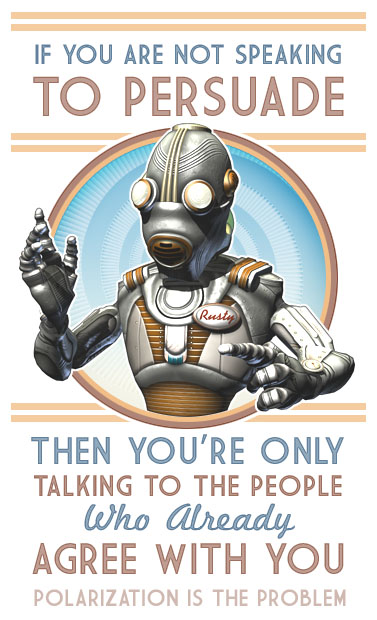
Image URL:
https://www.webomator.com/memes/Persuade.jpg
Here’s a thing I know. It’s almost unheard-of for people to change their minds. And they will never change their minds if you do nothing but yell at them. When you challenge a person’s convictions – whatever they are – they respond as though you’ve assaulted them personally. It triggers the exact same reactions in the brain.
A better way to persuade, which ought to be the goal,
is to ask them why they think the way they do. And really listen to their answer. Talk to them about their answer. Then tell them, from your own personal experience, why you think differently. Keep it on that personal level, because what you have to do is let them see why you disagree. You need them to understand that a rational person can have valid reasons for thinking the opposite of the way they think.
If you can accomplish that, you’ve achieved conversation. Don’t stop.
Social media has helped us create bubbles in which we only communicate with people who think the way we think. People are shocked and defensive when some Other Kind of Person appears. But it’s only in talking to those Other People, and particularly in listening to them, that understanding is possible.
When neither side wants to understand, the only thing left is war.
If you use the meme above in response to a person who disagrees with you, it’s not likely to help (though it might!). But it may do some good for the people inside your own echo chamber. Remind them that preaching to the choir is a waste of their time. It’s a real weakness in activists of every kind.
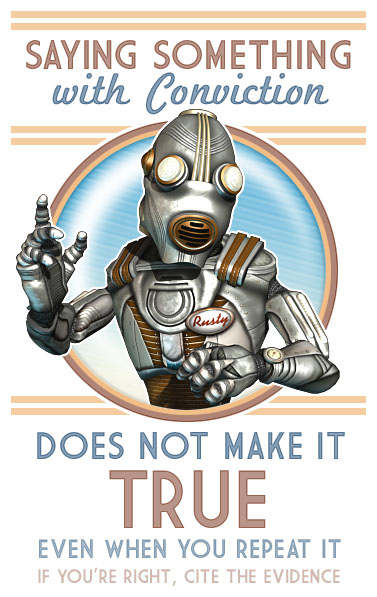
Image URL:
https://www.webomator.com/memes/Conviction.jpg
Obvious, but so necessary. And this one’s also a problem with echo chambers: because in your own personal bubble you can make forceful restatements of what all your friends believe, and everybody feels good about that. About themselves.
The problem is that so many things that “everybody knows” are downright false. These empty blanket pronouncements are a prime target for people who disagree.
So there you go. Rusty’s got a meme just for unsupported statements.
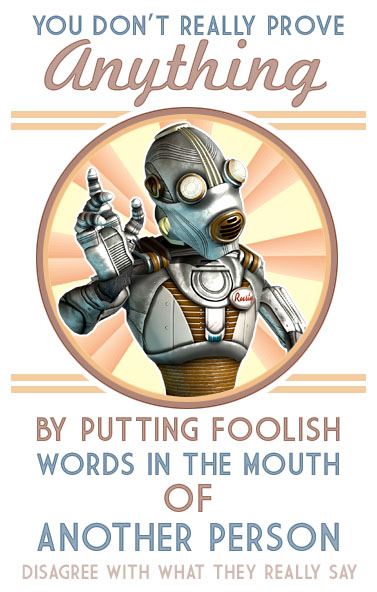
Image URL:
https://www.webomator.com/memes/StrawMan.jpg
Of all the lousy tactics in arguments, the straw man is one of the two I like least.
The straw man argument is lazy. You don’t dispute the things that people have said, because that would be hard. No, instead you invent the most ridiculous possible paraphrase of what you claim they really mean; then you belittle and mock that paraphrase.
You use the straw man when you have no way to deal with the real opinions of real people. That says a lot more about you than it says about the people you’re “arguing against”.
If you’re right, and they’re wrong, it’s their actual words you need to address. Arguing with imaginary people is pointless and sad.
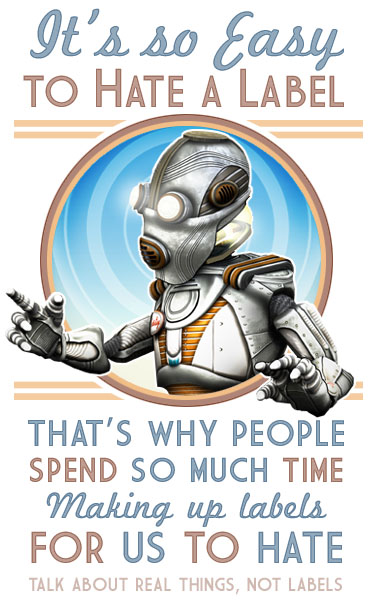
Image URL:
https://www.webomator.com/memes/Labels.jpg
This is an area where congressional Republicans really hold the crown. Take an idea, or a piece of legislation, or an issue that you don’t like; make up a short, dismissive name for it that your voters are certain to hate; and use that label, and no other language, to describe the issue. It’s like the straw man in that you’re fighting against a thing you’ve invented rather than the real thing.
That’s why the Affordable Care Act is referred to as Obamacare; why the alleged results of that plan were called Death Panels; and why the inheritance tax is called the Death Tax. That last one’s my favorite: those who rail against the Death Tax are unaware that inheritance taxes were proposed and signed by a Republican president, for reasons that would surprise them.
Among the rank and file short, derisive names are applied to people, as well. “Obummer” for Obama is one example. And unfortunately the folks on the other side have begun to do this, too.
It’s relatively hard to hate a real person. But it’s pretty easy to hate a label, especially when that label was designed to make you hate.
Labels are simple; real things are complicated. You don’t get anywhere by debating a label. Real disagreements are about the things the labels misrepresent.
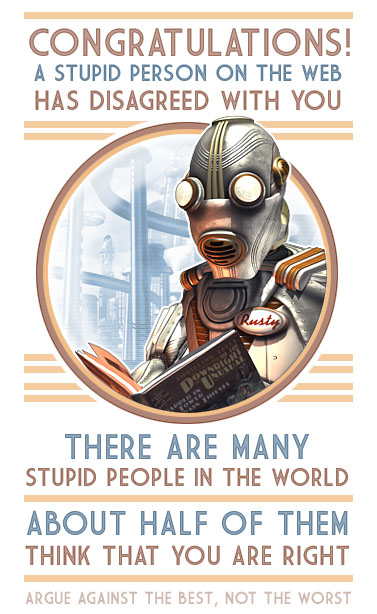
Image URL:
https://www.webomator.com/memes/Stupid_People.jpg
We all delight in seeing foolish statements by foolish people when those people hold the opposite side in an argument. So we repost and retweet and spread this evidence that our opponents are idiots.
But idiots are everywhere. They’re available in any flavor. For every stupid person who disagrees with you, there will be at least one stupid person who thinks you’re right.
So pointing out the stupidity of these people is pretty meaningless, isn’t it? It’s just one of those things that makes the folks inside your echo chamber feel superior.
Yeah, that’s an attractive thought. You feel good because someone else is stupid.
It’s also pretty easy to mock the stupidity of others. It’s far more difficult to address the arguments of people who are smart.
If you’re convinced that only stupid people disagree with you, there’s a pretty good chance that you are not one of the smart ones.
As far as Rusty and I can manage, these memes don’t favor any biases, especially not my own. They’re intended to be completely neutral and suitable for users with any opinion.
Because the goal is not to score points. The goal is to elevate discourse.
So use them if you like, but I hope you’ll use them in their intended spirit: not to “win”, but to guide discussions toward a genuine conversation.
If you want to cheat, though? Use these only on the people with whom you agree. Who knows? Your side may pull ahead in the the arms race.
This entry was posted on Tuesday, January 17th, 2017
and was filed under Can't Stop Thinking, Works in Progress
There have been 2 Responses »
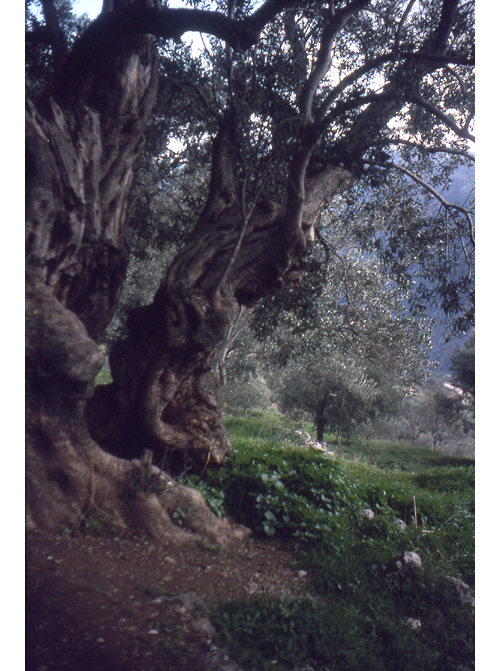
Back in 1979-80 I spent a winter in Greece. It was colder than you’d expect, but it was the cold of Sophocles. So not so bad.
I was there on a grant from a Canadian foundation. The idea was that I would broaden my artistic horizons and paint, which was exactly what I wanted to do, and so it was a good deal for me. I’m not sure how they felt about it.
So The Best Girlfriend In The World Except For That One Thing and I settled into a little house, which everybody called a villa, in a village called Pallini outside of Athens. Pallini had been there for a long time; in Roman times it was the site of a marble quarry, and there were odd bits of marble sculptures all over our house’s long, narrow, steeply sloping yard. An old marble cornice was our doorstop.
We’d been warned to keep the yard’s gate locked “or the Gypsies will get in” so of course we never locked the gate, but the Gypsies never showed up. I’ve always wondered where they were.
We made this house our base of operations. We’d explore Athens, and we’d take off for short trips to Delphi and the North, but we’d always have the villa when we were done. And it was a nice place. We’d spend an afternoon visiting the son of the local vineyard, or we’d take off into the hills outside the village, or we’d mock the village goats, who were asking for it.
I’m pretty sure those trees up above were Pallini trees. So you can see it was a nice place to wander in.
There came a day when The Best Girlfriend In The World Except For That One Thing and I headed up the road out of the village and into the hills, and we went in a direction we’d never taken before. I don’t know why. But there are a lot of directions, when you think about it, and for whatever reason we’d just never used this one. It led us through a little valley.
There was a farm on one side of the valley, and somewhere on that farm there was a dog. We never saw it. We heard it, though: it was barking. The dog would bark, and a moment later the echo of its bark would bounce back from the other side of the valley. So the dog would bark again.
And the The Best Girlfriend In The World Except For That One Thing and I just stood there and listened for awhile. Bark; pause; echo; bark; pause; echo. Again and again.
We were witnesses to the ultimate straw man argument, in the ultimate echo chamber. Because that dog just couldn’t let Echo Dog have the last word. In a way I can’t quite explain, this was one of the most profound moments of my life. I had the sense that the Universe was explaining a mystery to us. And I think I was right.
A few hours later, The Best Girlfriend In The World Except For That One Thing and I came back through the valley. The dog was still barking. And although I know that this dog lost his argument with Echo Dog many years ago, I hope that his descendants have taken up the feud and are still out there barking, refusing to let Echo Dog have the last word even though – inevitably – he will.
Because that’s what we do.
This entry was posted on Monday, April 4th, 2016
and was filed under Can't Stop Thinking
There have been no responses »
Yesterday’s post of pen and ink drawings I did for The Runestaff proved to be so popular over on Facebook that I figured I should follow up with more.
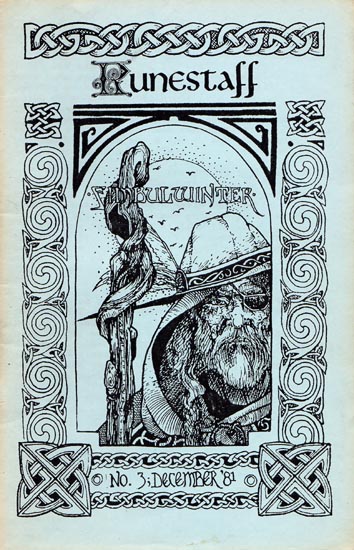
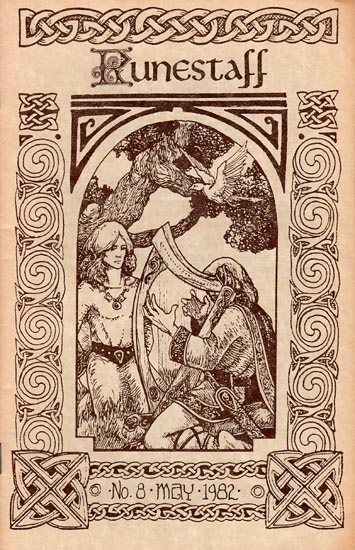
As I explained before, though, most of the drawings were auctioned off in fundraisers for the newsletter. I could only find about three or four more originals that I liked well enough to share. So instead I picked through the back issues and chose ten of the covers, which I’ve scanned right off the newsletters themselves.
That means that today’s quality isn’t as high. These covers are over thirty years old, and they were just photocopies even when they were young. But all the same, here they are.
I had plenty to say yesterday about my memories of The Runestaff. I doubt I have much to add here. So today, it’s mostly the pictures. As before there are so many of them that I’ve placed most under the “More” link below.
(more…)
This entry was posted on Sunday, January 17th, 2016
and was filed under Can't Stop Thinking, Works in Progress
There have been no responses »
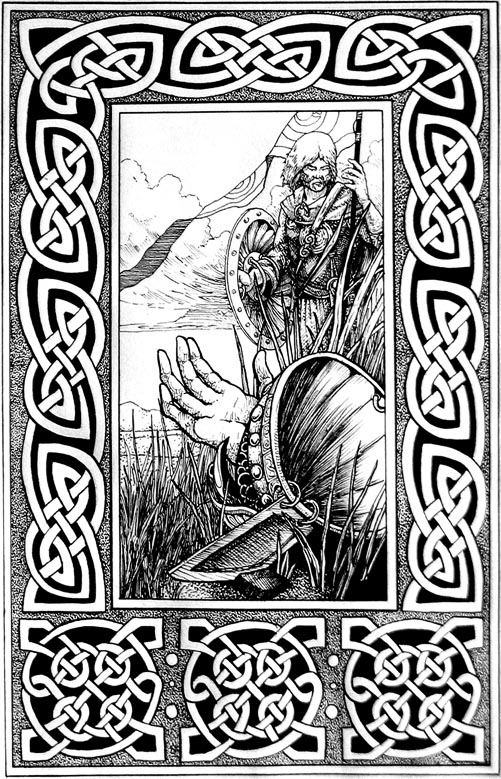
I guess I’ve only done a couple of retrospectives here at my blog. I have a kind of sheepish attitude about my oldest work, as you may have seen, in spite of that very early work being more visible than a lot of what I did afterwards. But today I’ve put together some slightly later work from the 1980’s. This is stuff that I remember with less embarrassment.
From 1981 through 1985, I first helped edit, and then edited, The Runestaff. This was a newsletter for the Barbarian Freehold Alliance, a large household within the Society for Creative Anachronism.
Freeholders were less interested in re-enacting the feudal system and more interested in cultures from the early Middle Ages. And… in parties: even when we were out of favor with the local feudals they still always came to our revels. Which were epic, as I recall. And we fought, of course, though not necessarily under the banners of the kingdoms where we lived. Sometimes we fought for the highest bidder, even when the bidding was in cookies.
Anyway, from its first issue through its thirty-fourth I drew most of the illustrations and covers for the little magazine, and I also wrote quite a bit of its content. While I don’t still have the originals for all of those drawings (most were auctioned off to support the newsletter and, well, me) I do still have some of them. I’ve gone through my stacks and scanned a selection of those drawings here.
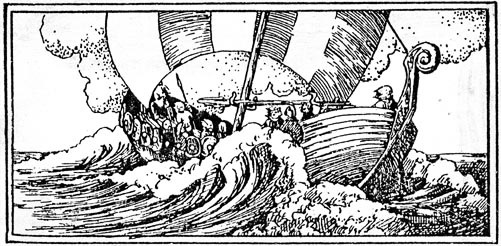
Because there are so many images I’ve put most of them after the jump. So jump!
(more…)
This entry was posted on Saturday, January 16th, 2016
and was filed under Can't Stop Thinking, Works in Progress
There have been 3 Responses »
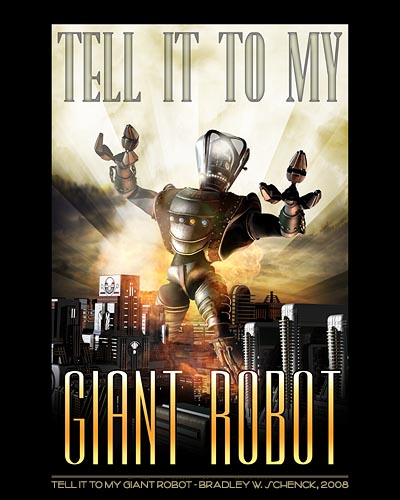
Sometimes I feel a little guilty about my mad scientists of Retropolis. That’s because I don’t normally think that our scientists are mad. Not, you know, muahahahaha, you cannot escape my Dessicating Diffracto-Ray mad.
But I have to say that any time the death rays and the giant robots and the curiously effective molecular destabilizers begin to get me down, I remind myself that there are avenues of research in our own Earth that are, to put it plainly, absolutely and positively demented. No. That’s not plain enough. What I mean is: bug-loving, glands to the wall crazy. Which is nearly plain enough.
For example, let’s look at robotics.
Recent advances in robotics include building robots that are fueled by meat. Wow, that’s nuts, right? So they did it again. With corpses.
But fueling robots with meat is pretty harmless, so long as robots can’t detect meat. So let’s make sure they can. In fact, let’s teach them to flense and debone meat. That’s better!
So now that the robots know how to prepare and eat meat, let’s ask them what they think of us, shall we? According to the robots, we are bacon. Mmmmm. Bacon.
But we shouldn’t worry, should we? At least they can’t escape. Oh, no, wait.
Okay. That is a little distressing. Shall we recap, then? We have built robots that are fueled by meat; we have taught them to recognize meat; they now know how to butcher meat; and we’ve made sure that they can get out of their paddocks and onto the streets.
What shall we do next? I know! Let’s build ANGRY robots!
That’s the kind of meditation I go through when I feel badly about the scientists of Retropolis. By the time I reach the end I don’t feel badly about them at all. Because I’m running down the street with a can opener in my hand and screaming that I am not bacon.
Oh, sure, the neighbors stare. But wait till they see what’s coming up behind me.
This entry was posted on Wednesday, May 13th, 2015
and was filed under Can't Stop Thinking
There have been 3 Responses »
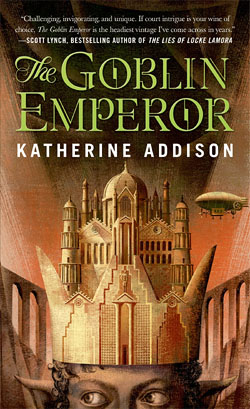
I really enjoyed The Goblin Emperor by Katherine Addison (Sarah Monette). I’m putting that right out front, because it would be too easy for you to think that I didn’t like it.
And when I say that I really enjoyed it, what I mean is that on two of the three evenings I spent with the book I stayed up late because I just didn’t want to stop reading it. I didn’t want to stop reading it in spite of the fact that its hero can Do No Wrong: his only missteps are when, for a moment, he wants vengeance… only to chastise himself for taking the low road, even in his mind, which of course makes us like him even more.
No, that wasn’t it. The thing that convinced me that I should not be enjoying the book is that it seems to mark the complete victory of Poughkeepsie.
I haven’t read much fantasy of the medieval or ancient sort in the past three decades, apart from Terry Pratchett; and Pratchett is really in a class of his own. I used to read a lot of fantasy, but at some point, I think unconsciously, I just stopped. I’m aware that what’s popular in fantasy has changed over the years. I just wasn’t really there to see it.
Back in 1973 Ursula K. Le Guin wrote an essay called From Elfland to Poughkeepsie. It’s really good; you should read it. In her essay Le Guin took a then popular fantasy author to task, very gently, for writing fantasies that didn’t need to be fantasies: fantasies that would work just as well if you pulled the fantastical characters out of the book and dropped them into Poughkeepsie. You see? The story and its dialogue would still make perfect sense, and would lose nothing, if they were placed in a fairly average modern day city.
So The Goblin Emperor is populated by elves and goblins who do not need to be elves and goblins. They have a few unique twitches (involving ears) but that’s the only thing that differentiates them from humans. The exact same story could be told with a setting in the Chinese empire, the Roman or Ottoman empires, or pretty much any empire you care to name, with hereditary bureaucrats, a disadvantaged underclass, and court intrigues. It has airships, but the fact that they’re airships doesn’t matter; they could as easily be cruise ships or, I guess, buses, because the fact that they are airships is completely incidental. There’s a small amount of magic (two instances, possibly three) that does not need to be magic. A little gas would have done the same thing.
My point is that this is a fantasy novel – a very good and enjoyable fantasy novel – that doesn’t depend on fantasy for anything that matters. It’s a very strange situation, but there it is. It’s Poughkeepsie.
What seems even stranger to me is that nobody seems to have noticed this, and I guess the reason why I’m surprised is that I just haven’t been paying attention to fantasy books. This may be what’s normal and expected now.
So The Goblin Emperor has given me a lot to think about, which is something that I like in a book. Such as: is this a bad thing? It’s an enjoyable book, so is it important that the fantasy elements be necessary to the story? And I’m still not sure.
You could say that fantasy has been mainstreamed to the point that a fantastic setting can simply be taken for granted, the way power lines and cars are taken for granted in a modern day mystery. But there’s something about that which makes me uneasy.
It bothers me that a book can be both fantastical and mundane.
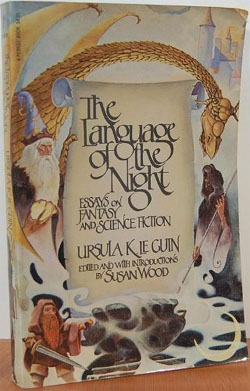 So after many years I’ve re-read From Elfland to Poughkeepsie, to find that Le Guin was mainly concerned about dialogue and prose style (and she would probably approve of those, I think, in The Goblin Emperor). The rest – my expectation that the fantasy elements of a fantasy story can’t be separated from the story without turning it to nonsense – that’s all me, I guess. But it seems like a natural progression.
If you start out in Elfland but head in the direction of Poughkeepsie, it shouldn’t be any surprise to find that you’ve arrived there: that everything around you now sounds and smells and feels like Poughkeepsie, in spite of the bit of glamour that’s laid on top; in spite of the fact that, now and then, your ears twitch. So maybe – because I skipped the many miles that have passed between the late eighties and the present day – I’m just really surprised to see where I am.
As I said at the start, I liked the book. Weeks later, I’m still thinking about it, and to me that’s a very good sign. So this isn’t a criticism: this is just a question that I’m asking myself.
Let us consider Elfland as a great national park, a vast and beautiful place where a person goes by himself, on foot, to get in touch with reality in a special, private, profound fashion. But what happens when it is considered merely as a place to "get away to"?
Well, you know what has happened to Yosemite. Everybody comes, not with an ax and a box of matches, but in a trailer with a motorbike on the back and a motorboat on top and a butane stove…. They arrive totally encapsulated in a secondhand reality. And then they move on to Yellowstone, and it’s just the same there….
… The same sort of thing seems to be happening to Elfland, lately.
– Ursula K. Le Guin, in From Elfland to Poughkeepsie
This entry was posted on Monday, April 20th, 2015
and was filed under Can't Stop Thinking, Reading / Watching / Consuming
There have been 4 Responses »


I’ve reached that stage in life when the people I’ve admired for as long as I’ve been admiring people have begun to disappear at what’s probably an accelerating rate. There are obvious reasons why I think that’s a shame; some selfish (it’s proof that aging is going on, somewhere near me) and some, maybe, unselfish (because I’m sorry for all of us that these folks aren’t here with us any more).
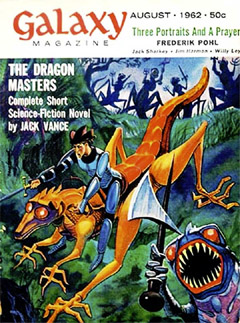
So this week, it’s Jack Vance.
I try to avoid eulogizing people I didn’t actually know. After all, who am I to weigh in? So I’ll just say that even though I try to avoid having favorites, Vance was still a favorite writer of mine because he was just way too good to yield to my policy of unfavoritism. I mean, you just couldn’t keep him down. And though he hadn’t been writing for quite some time his body of work is still every bit as wonderful as it ever was. If you don’t know that work, you ought to.
Now the world is full of people who did know, or work with, or correspond with Jack Vance. What they have to say about his passing is a lot more compelling than anything I could write. I noticed a curious symmetry in two of these: Matthew Hughes remembers his first exposure to Vance through the magazine publication of The Dragon Masters, while Frederik Pohl remembers publishing it. Taken together they’ll tell you about 10% of what you should know about Vance: the rest, you’ll get by reading him.
This entry was posted on Friday, May 31st, 2013
and was filed under Can't Stop Thinking
There has been 1 Response »


 HiLoBrow.com has announced the launch of HiLo Books, an imprint dedicated to what they call Radium Age Science Fiction – because, after all, what the genre needs is more labels. By "Radium Age" they mean science fiction written between the years of 1904 and 1933, bounded on the one hand by the scientific romances of Jules Verne, Edgar Alan Poe, and H. G. Wells, and on the other (the upper?) hand by the Golden Age works of writers like Asimov and his contemporaries.
I have a problem with labels. Still, since HiLoBrow is effectively creating a brand I can understand why they’d want to find some label to distinguish it from everything it’s not.
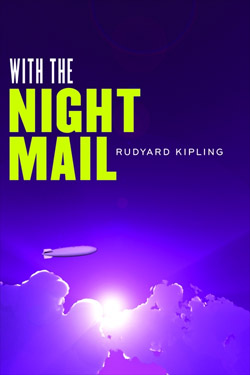
The lineup of releases for 2012 is a pretty promising one – there’s Jack London’s The Scarlet Plague, Rudyard Kipling’s With the Night Mail, and Arthur Conan Doyle’s The Poison Belt; taken together, these show a united front of mainstream writers from the period who each experimented with speculative fiction.
 If it all sounds a little bit like someone who’s desperate to be taken seriously, I expect that’s fine. A series like this exists in part to draw new readers into the scary, nerdy depths of science fiction in a way that seems comfortable, and even respectable .
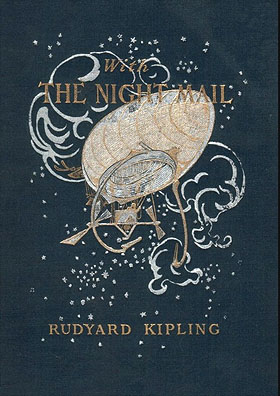
What I can’t understand, though, is the books’ covers. They look like something out of the ranks of the worst of Amazon’s self-published novels. It’s especially confusing because the folks at HiLoBrow certainly know what good book covers look like, either for these same works or for their own. Their earlier Wage Slave’s Glossary has a handsome cover by Seth, and they’ve showcased a beautiful gallery of period book covers including this lovely one for With the Night Mail.
So there’s no question that they know that books can be beautiful. I don’t understand why they want to publish ones that are pretty much the opposite.
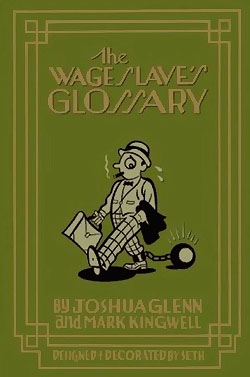 This led me to wonder whether these books aren’t the slapped together Amazonian things they resemble; and trying to answer that question led me right down the rabbit hole.
First, HiLoBooks has a distributor for its books. So there can’t be much doubt that there will be a warehouse of their books someplace – PGW also handles Archaia Studio Press, Nolo Press, Cricket Books, and plenty of other familiar independent and small press publishers. It sounds like we ought to be safe from some of the self-published horrors at Amazon (full disclosure: I’m also self-published, though I hope not horribly, at Amazon)
Second, HiLoBooks – according to their press release – will be an imprint of ‘Cursor, Richard Nash’s “publishing platform of the future”.’ Since a visit to the Cursor web site was completely uninformative I dug deeper, to find Nash’s talk at BookNet Canada’s Technology Forum. In this talk (""Publishing 3.0: Moving from Gatekeeping to Partnerships") Nash admits more than once that he’s speaking in very abstract terms. Those terms are in fact so abstract that at the end of the presentation I still had no idea what Cursor was supposed to be.
You’ll see in the talk that Publishing 3.0 (more labels!) is supposed to be an upgrade for the role of publishers in which books themselves become just one aspect of the relationship between readers and writers; in which that relationship has now become the focus of publishing, since so many large and small interactions within that community – including the sale of books – can be sources of profit for a publisher.
But if, like me, you’re left scratching your head and wondering first, what that means, and second, why a publisher deserves to monetize every aspect of the relationship between authors and their audience, well, your head is just going to get scraped bare from all the scratching. The answer isn’t in there. The subtitle of the talk is "From Gatekeeping to Partnerships", but it sounds more like "From Gatekeeping to Super-Gatekeeping".
Like the music industry, the book publishing industry probably feels as though it’s besieged by new technologies and the uses we find for them. Nash’s "Publishing 3.0" seems to be a response that’s in direct opposition to the way things are headed. By "the way things are headed", I mean that we seem to be on the verge of a world where there are no gatekeepers; where, for better or worse, artists are left to deal directly with the community. This requires marketing, which is one of the traditional roles of a publisher; but it’s by no means certain that publishers will be the ones doing that marketing. The "Publishing 3.0" of Cursor looks like a plan to establish a whole new level of gatekeeping in which every interaction between writers and their audience is owned by the publisher. That’s why I called it "Super-Gatekeeping".
What would publishers bring to the table, to make that look like a good deal for the writers and their readers?
There is just the glimmer of an answer – to half that question, anyway – in a post at Nash’s own blog.
For writers…
No more life-of-the-copyright contracts.
Instead: three year contracts.
Yup, from a contract that locks you in till seventy years after you’re dead, to a three year contract. Renewable annually thereafter. Which means after three years you can walk. Or stay, but stick it to us for better royalties because there’s gonna be a movie. Or stay with us because with all the additional formats and revenue opportunities we’re creating above and beyond what any publisher has to offer, you’re making more money than ever before.
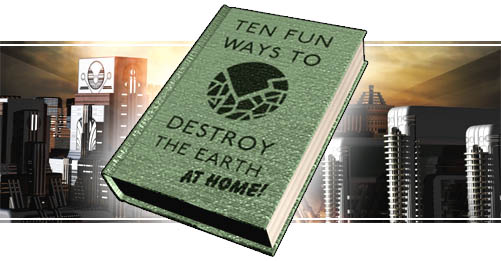
This seems to translate to "We will own every cell in your body, but only for a little while". It doesn’t take too long a trek down memory lane to recall how many writers and artists were willing to do original work for hire just because they had to and how this sometimes left them excluded from very lucrative extensions to their work (Siegel and Shuster, or Jack Kirby, are the obvious examples in comics publishing). So in a Cursorized world, maybe creators would figure that assigning a publisher complete and total ownership – which might be temporary – is the price of doing business.
Nash’s talk establishes some comfy small press credentials (starting a publishing company during the night shift at Kinko’s) but the end product seems like something out of a dystopian novel. I don’t mean that in a good way, if you were wondering.
And with "dystopian novel", I seem to have come full circle and landed on the back of HiLoBooks. I wish them well, especially if they didn’t really mean for us to believe in those book covers. But I’m not sure about the company they’ve chosen to keep. I suppose that (their authors being dead, after all) one half of my misgivings about Cursor are unfounded in HiLo’s case. That leaves a not inconsiderable amount of discomfort, though.
This entry was posted on Sunday, January 8th, 2012
and was filed under Can't Stop Thinking, Found on the Web
There have been no responses »