A few months ago I started to keep a running tally in my blog’s right sidebar. It lists the books I’ve just read. I don’t think I’ve ever commented on that in any of my posts, and I can only recall one time that I’ve written about one of those books since I started to list them.
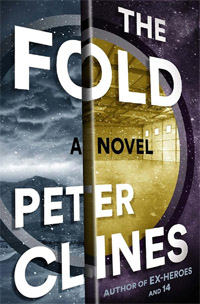
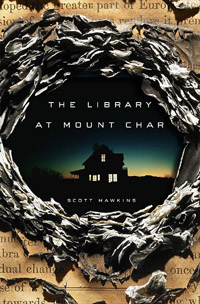
But this week has been exceptional so far, starting with Peter Clines’ The Fold and continuing with Scott Hawkins’ debut novel The Library at Mount Char.
In The Fold, we follow an independent contractor who’s hired to analyze a secretive scientific project that’s built what its creators call “The Albuquerque Door”. The Door is the end result of their experiments in teleportation. Those experiments ground to a gruesome halt when an animal experiment went wrong; but the team recovered, changed the direction of their research, and now have what seems to be a completely functional and safe teleportation system. They just won’t tell anybody how it works.
Hence the independent audit of their program. Now, the first twist is going to be a pretty obvious one. You’ll have figured it out after the first chapter. The characters (who don’t have the advantage of knowing that they’re in a book) will take quite a bit longer to get there. Is that tedious? No, not at all, especially when it turns out that that twist isn’t what you thought it was, exactly, and – oh, look! – things just keep getting stranger until you (and those characters) find yourself someplace you never thought might exist. Once you’ve found it, you’ll want to get the heck out of there as quickly as you can. If you can. Because of what’s been waiting there.
Scott Hawkins’ The Library at Mount Char is a very different kind of book.
Twelve children were adopted, years ago, by someone they know only as Father. Father is a kind of head librarian in a library that has twelve catalogs, or fields of study. Each child is assigned to learn one of them. Father, as you might expect, has mastered them all.
The children are raised to adulthood and the mastery of their own catalogs before the story really begins: that is, when Father disappears.
If the library’s catalogs are out of the ordinary, they’re nothing compared to Father’s child-rearing technique. Discipline is harsh. Because one of his many talents is the ability to raise the dead, Father’s discipline can be fatal without being final: and so it is, very often, and in completely horrific ways.
As a result, most of the adults who were the children are not people you’d really like to know.
This book (which I think is remarkable) won’t be for everyone. There are really, really awful things in here, and quite a few of those things happen to the children.
But not only to the children. When Father vanishes we start to see that he had powerful enemies who aren’t any more human than he was, and at least one enemy who is much more human than he was. The entire world enters into a period of chaos and disaster as the survivors struggle to find Father or take his place. And that’s a challenge: one reason why it’s so hard to fill Father’s shoes is that he’s been wearing them for more than sixty thousand years.
While the central mystery may seem at first to be “Who and what is Father?” that’s not really what the book is about. It’s much more about revenge, and the cost of revenge to the avenger, and whether that cost is irreparable. Add a dash of “What does it mean to be (nearly) human?” and simmer gently over sacrifice, bravery, a surfeit of power, and all of the damage done. Enjoy till the finish. You’ll never think about the Sun in the same way again.
Also: lions. Just the most amazing lions.
This entry was posted on Thursday, June 25th, 2015
and was filed under Reading / Watching / Consuming
There have been no responses »
David Walton’s Superposition is a book that offers lots of fun, from experiments in a supercollider to courtroom drama, with each of those threads entangled by a technology that projects quantum effects up to the classic, Newtonian scale. It’s fun for the reader, I mean; it’s more like the opposite of fun for its characters.
It’s hard to get specific here without being spoilery.
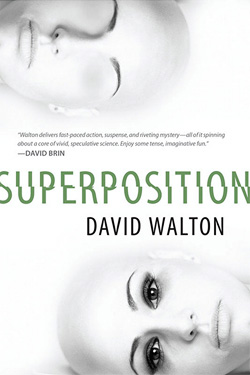 Once you’ve read the first few chapters you’ll understand one of the fundamental things about the book; like most everything else, this hangs on an effect of quantum physics. You won’t be sure how much more of that you’ll encounter as you go on.
The book could be seen as an expansion on the famous thought experiment of Schrödinger’s Cat – which is described, at one point – and the reader has to keep wondering just how many probability waves are collapsing (or not collapsing) as time goes on.
You ought to expect a certain amount of handwavery here, seeing as we don’t actually know how to edit the laws of physics on a local scale. This technology isn’t understood by the characters, either, so it gets a convenient pass. I was left wondering a bit about how a part of their own technology (“smart paper”) can run software that projects its effects into the physical world. This was a small, nagging bit that did bother me.
But by the time that comes up we’ve seen so much that’s (reasonably) inexplicable that this may not trouble everyone. Quantum theory itself is described in terms that even a common mortal – me – can understand. But what it does…!
Another lovely part of the book is also tied up with spoilers, but it concerns the family relationships that are wounded, patched up, and sometimes survive while the structure of reality is torn one way or the other. Superposition succeeds on levels that aren’t limited to the quantum and classical.
This is the first book of Walton’s that I’ve read, but I’m now looking forward to its sequel (Supersymmetry ) as well as Quintessence
 , an Age of Exploration tale in which science has proved that the world is flat.
This entry was posted on Sunday, May 31st, 2015
and was filed under Reading / Watching / Consuming
There have been no responses »
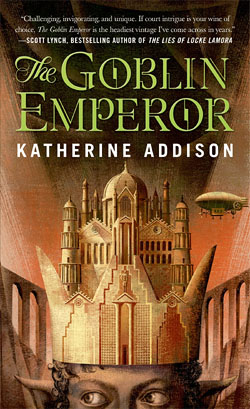
I really enjoyed The Goblin Emperor by Katherine Addison (Sarah Monette). I’m putting that right out front, because it would be too easy for you to think that I didn’t like it.
And when I say that I really enjoyed it, what I mean is that on two of the three evenings I spent with the book I stayed up late because I just didn’t want to stop reading it. I didn’t want to stop reading it in spite of the fact that its hero can Do No Wrong: his only missteps are when, for a moment, he wants vengeance… only to chastise himself for taking the low road, even in his mind, which of course makes us like him even more.
No, that wasn’t it. The thing that convinced me that I should not be enjoying the book is that it seems to mark the complete victory of Poughkeepsie.
I haven’t read much fantasy of the medieval or ancient sort in the past three decades, apart from Terry Pratchett; and Pratchett is really in a class of his own. I used to read a lot of fantasy, but at some point, I think unconsciously, I just stopped. I’m aware that what’s popular in fantasy has changed over the years. I just wasn’t really there to see it.
Back in 1973 Ursula K. Le Guin wrote an essay called From Elfland to Poughkeepsie. It’s really good; you should read it. In her essay Le Guin took a then popular fantasy author to task, very gently, for writing fantasies that didn’t need to be fantasies: fantasies that would work just as well if you pulled the fantastical characters out of the book and dropped them into Poughkeepsie. You see? The story and its dialogue would still make perfect sense, and would lose nothing, if they were placed in a fairly average modern day city.
So The Goblin Emperor is populated by elves and goblins who do not need to be elves and goblins. They have a few unique twitches (involving ears) but that’s the only thing that differentiates them from humans. The exact same story could be told with a setting in the Chinese empire, the Roman or Ottoman empires, or pretty much any empire you care to name, with hereditary bureaucrats, a disadvantaged underclass, and court intrigues. It has airships, but the fact that they’re airships doesn’t matter; they could as easily be cruise ships or, I guess, buses, because the fact that they are airships is completely incidental. There’s a small amount of magic (two instances, possibly three) that does not need to be magic. A little gas would have done the same thing.
My point is that this is a fantasy novel – a very good and enjoyable fantasy novel – that doesn’t depend on fantasy for anything that matters. It’s a very strange situation, but there it is. It’s Poughkeepsie.
What seems even stranger to me is that nobody seems to have noticed this, and I guess the reason why I’m surprised is that I just haven’t been paying attention to fantasy books. This may be what’s normal and expected now.
So The Goblin Emperor has given me a lot to think about, which is something that I like in a book. Such as: is this a bad thing? It’s an enjoyable book, so is it important that the fantasy elements be necessary to the story? And I’m still not sure.
You could say that fantasy has been mainstreamed to the point that a fantastic setting can simply be taken for granted, the way power lines and cars are taken for granted in a modern day mystery. But there’s something about that which makes me uneasy.
It bothers me that a book can be both fantastical and mundane.
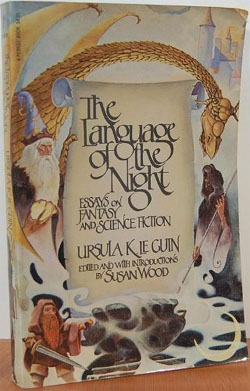 So after many years I’ve re-read From Elfland to Poughkeepsie, to find that Le Guin was mainly concerned about dialogue and prose style (and she would probably approve of those, I think, in The Goblin Emperor). The rest – my expectation that the fantasy elements of a fantasy story can’t be separated from the story without turning it to nonsense – that’s all me, I guess. But it seems like a natural progression.
If you start out in Elfland but head in the direction of Poughkeepsie, it shouldn’t be any surprise to find that you’ve arrived there: that everything around you now sounds and smells and feels like Poughkeepsie, in spite of the bit of glamour that’s laid on top; in spite of the fact that, now and then, your ears twitch. So maybe – because I skipped the many miles that have passed between the late eighties and the present day – I’m just really surprised to see where I am.
As I said at the start, I liked the book. Weeks later, I’m still thinking about it, and to me that’s a very good sign. So this isn’t a criticism: this is just a question that I’m asking myself.
Let us consider Elfland as a great national park, a vast and beautiful place where a person goes by himself, on foot, to get in touch with reality in a special, private, profound fashion. But what happens when it is considered merely as a place to "get away to"?
Well, you know what has happened to Yosemite. Everybody comes, not with an ax and a box of matches, but in a trailer with a motorbike on the back and a motorboat on top and a butane stove…. They arrive totally encapsulated in a secondhand reality. And then they move on to Yellowstone, and it’s just the same there….
… The same sort of thing seems to be happening to Elfland, lately.
– Ursula K. Le Guin, in From Elfland to Poughkeepsie
This entry was posted on Monday, April 20th, 2015
and was filed under Can't Stop Thinking, Reading / Watching / Consuming
There have been 4 Responses »
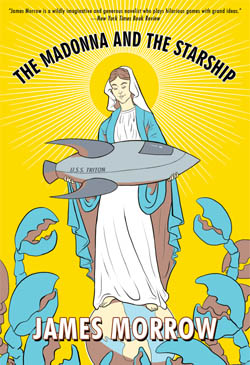 Over at Locus there’s an interesting emailed conversation between two writers I’ve discovered and enjoyed lately. They’re James Morrow (The Madonna and the Starship) and Daryl Gregory (Afterparty and the upcoming We Are All Completely Fine).
Their two recent books each deal in some way with faith or religion, but not from a standpoint you might expect. Neither book hands you a conclusion on the tension between faith and reason. But the authors take you to some pretty interesting places along the way.
I’m very fond of Henry Kuttner’s humorous stories. The Madonna and the Starship is the closest thing I’ve ever seen to a modern work in the vein of Kuttner’s Gallegher or Hogben stories: Morrow gives us bizarre aliens with bizarre intentions, and frenzied protagonists who have to find a way to deal with them. The book is straight out of Kuttner’s era, too, since it’s set in the live television studios of the 1950’s. It is about the most fun you can have in a philosophical novel, with or without big blue lobsters.
And that’s really what it is: a story about warring philosophies. If "warring" sounds like an exaggeration, I have two words for you: death rays.
 Afterparty isn’t that kind of screwball comedy. Afterparty introduces a drug that makes your brain experience religious certainty: it’s like the way that psychedelic drugs fire off the synapses that tell you you’ve just had a profound insight. ("Doughnuts… and zebras! Of course!")
People who take this drug are certain that there is a god, though that god varies from person to person. That certainty stays with them unless they stop taking the drug: this makes withdrawal a pretty serious matter. It’s not a good thing for an extremely religious person to find that god’s vanished.
And if you overdose? You actually see and hear your god, your angel, or your demon. All the time. Forever.
The drug’s been buried under patents that should prevent it from ever escaping into the world. But of course that’s not what happens. What does happen is very interesting.
Anyway, these are two great books that you should read right now, and there’s a discussion by their authors at Locus.
This entry was posted on Friday, July 18th, 2014
and was filed under Reading / Watching / Consuming
There have been no responses »
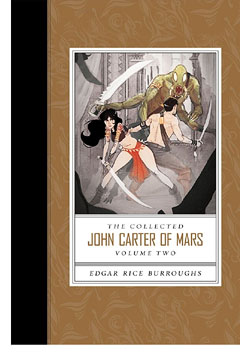 To coincide with their upcoming movie, Disney has collected all of Edgar Rice Burroughs Mars books in three volumes of Barsoomian adventure. The whippersnappers of today will have to do without the wonderful old Roy G. Krenkel and Frank Frazetta illustrations that I remember, but these look like handsome editions anyway.
Volume 1: A Princess of Mars; Gods of Mars; Warlord of Mars
Volume 2: Thuvia, Maid of Mars; The Chessmen of Mars; The Master Mind of Mars; A Fighting Man of Mars
Volume 3: Swords of Mars; Synthetic Men of Mars; Llana of Gathol; John Carter of Mars
Now everybody can count the number of times that John Carter refers to himself as "The greatest swordsman on two planets"! Not suitable for drinking games.
They’re out in paperback and for the Kindle.
[tags]edgar rice burroughs, mars, barsoom, john carter, reprint, mars novels, science fiction, space fantasy, vintage, books[/tags]
This entry was posted on Thursday, February 9th, 2012
and was filed under Found on the Web, Reading / Watching / Consuming
There have been 3 Responses »


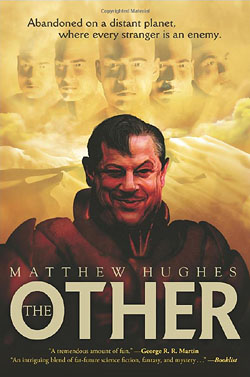
If you haven’t read Matthew Hughes’
The Other then, on the bright side, you have something to look forward to.
Of course if you have read The Other, there may still be a bright side: because although they haven’t (yet?) been collected in print you can now download ePub formatted digital versions of seven short stories about the more or less hero of The Other, Luff Imbry from their publisher, Angry Robot Books.
They’re each less than a dollar (if my inner currrency exchange is working) and they will fit just fine on your Nook, Sony Reader, iPad, or anything else that can read an ePub book, including your computer.
Luff Imbry is a bit of a rascal. He’s an antiquities trader who specializes in recently redistributed wealth and, sometimes, in wealth that hasn’t quite yet been redistributed, but could be. He’s a gifted forger, too, and in that (at least) he reminds me of Jonathan Gash’s Lovejoy mysteries… though since he’s quite gifted in the girth department, Luff Imbry may be more of a heavyweight.
Angry Robot’s FAQ also suggests the stories may be available in the Amazon Kindle Store , but as you can probably see from that click I couldn’t find them there. Maybe they’ll show up in the near future.
Hughes’ Archonate novels are often compared to the science fiction and fantasies of Jack Vance, and with good reason; in fact we discover along the way that the Archonate’s Earth may even be the Old Earth of Vance’s Dying Earth stories… just a little while before the balance of the Universe shifts back to magic (or "sympathetic association") from its more rational state of science.
They’re fine stories, and wonderfully well told, and you just ought to go and read them if you haven’t. A good place to start might be Majestrum.
[tags]matthew hughes, archonate, the other, luff imbry, science fiction, epub, digital book, ebook, sont reader, nook, ipad[/tags]
This entry was posted on Sunday, January 15th, 2012
and was filed under Found on the Web, Reading / Watching / Consuming
There have been no responses »
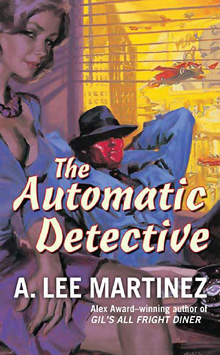
 Oh, no: we’re not talking about laying out on the beach here, noses buried in the latest action-packed political thriller to bombard the airport bookshelves. Nope, here in the Secret Laboratory “holiday reading” means packing up the snow shovel and burrowing (physically) into a pile of warm anythings while burrowing (mentally) into a few hundred pages of Something Else. Holiday reading is serious business.
Though that doesn’t preclude comedy.
The Empire City (also known as Technotopia) of The Automatic Detective is a place in which the cheerful exuberance of the retro future all came true, sort of, in ways that were a bit unexpected. So, yes, we’ve all got a shot at a flying car, but in practice the gadabouts of Empire City are not exactly standardized and the many models are each plagued by niggling problems like, for example, the Buzzbugs: you’d call them ornithopters, except that their plastic wings and their beelike bodies are based on insects rather than birds. They’re a swell idea, but they have this habit of stalling, which is not your optimal behavior in a flying car. Opting out of the Buzzbug, you might try a Hoverskid, unless you were quick enough to ask yourself what the “Skid” part of their name was all about. In fact there’s only one model in all of Empire City that rolls on wheels, or more accurately, on wheel: that would be the Unipod.
Every one of these vehicles is fatally flawed in a unique and inventive way. And that tells you a lot about Empire City. The City’s a victim of almost random invention. Yesterday’s advances get recycled and today’s ill-advised replacements show up to crash, burn, mince, and mangle all over again. The question of why, exactly, that is, is rarely asked. Until we meet Mack Megaton.
Mack is not an automatic detective. Mack is a cab driver, although originally he was an unusual (and unusually dangerous) robot built by a mad scientist intent on (you guessed it!) dominating the world. For one reason or another, though, Mack decided that he’d rather not go in for world domination – which led to his creator’s imprisonment in a place I really, really wish I’d made up myself. It’s the Moriarty Asylum for the Criminally Inventive.
Mack is better now. He’s in therapy. But folks are still just a little bit worried about what would happen if his original programming were to kick back in.
And that’s where we begin. The Automatic Detective invites us on a hard boiled adventure through this dysfunctional World of Tomorrow where we meet all sorts of characters we didn’t quite meet in Raymond Chandler’s stories – like Jung, the intelligent gorilla, who’s Mack’s best friend, and like small, green and sinister scientists, and like Lucia: a swell dame, maybe. And, you know, maybe not.
The real journey here is Mack’s passage toward something like humanity. The story’s propelled by his decision at the beginning to break into a domestic disturbance at his neighbor’s apartment and that, as mundane as it sounds, is the first step in both the mystery of what the heck made Empire City what it is, and Mack’s growth as a sentient, if mechanical, being.
An Automatic Detective, in fact. Just picture Philip Marlowe. But paint him red, add few hundred pounds of near-indestructible shell, and don’t forget a buried inner drive to Destroy All Humans.
This entry was posted on Sunday, December 5th, 2010
and was filed under Reading / Watching / Consuming
There has been 1 Response »
This entry was posted on Saturday, March 20th, 2010
and was filed under Found on the Web, Reading / Watching / Consuming
There has been 1 Response »
I used to wonder if my sleeping self were a completely different creature than the waking me who’s typing this now. My sleeping self, I thought, had his own personality, his own urge to survive, and simple wants: to be left alone so he could survive – which meant, of course, not waking up.
My sleeping self could carry on a short conversation. He might promise to do anything, if it seemed like once he’d made the promise, he’d get to survive (sleep). He even might answer the phone and do those things remotely. Once he picked up the phone and just said “Why are you doing this to me?” before he hung up.
He had a fairly short window in which to make the world go away because after a couple of minutes the waking me would take his place. So he was wily. Often enough I found myself dealing with what he’d done as my day went on.
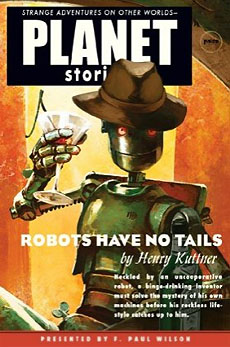
But the sleeping me was nothing compared to the alternate self of Galloway Gallegher, as we see in this collection of short stories by Henry Kuttner.
Gallegher, says Gallegher, does science by ear. He doesn’t know how. Somehow – in spite of not having a lot of formal training – his subconscious has picked up a lot of knowledge along the way and if his conscious mind just gets out of its way it can do such amazing things that it makes him the most gifted – if unusual – inventor in the world.
Fortunately for his subconscious, this happens when Gallegher is supremely drunk. It’s fortunate because that happens pretty often.
And that’s the setup for each of these stories – because although Gallegher (drunk) can solve just about any problem that’s presented to him he does it "by ear", using whatever materials are at hand – and sometimes, whatever he can have delivered. He doesn’t make notes, and he’s suspicious of any attempt to record what he’s up to. He’ll meet with clients, cobble together some bizarre machine to solve their problems – often more than one at a time – and then pass out, leaving Gallegher (sober) to try to figure out what’s happened. Why, for example, he now has a machine that’s eaten all the dirt in his back yard and does nothing else except to sing "Saint James Infirmary". And, just as often, why everyone seems to be out to get him.
I remember Henry Kuttner mainly for his fantasy stories from the 1940s and 1950s. They were among the many pulp stories reprinted when I was young. Discovering these, though, was a great pleasure – they’re science fiction screwball comedies, and I just wish there were more of them.
Four of the five Gallegher stories were written in 1942 (under the name Lewis Padgett), before Kuttner went off to war. The last was published in 1948. The near-future world of these stories is one in which rapid changes in technology have confused matters a bit – especially in the legal system – and that makes us feel right at home there, doesn’t it?
These stories were first gathered together as a book in 1952. This Planet Stories edition has a new cover by Tomasz Jedruszek and some fine interior illustrations by Brian Snoddy, a new introduction by F. Paul Wilson, and the original 1952 introduction by C.L. Moore – Kuttner’s wife, herself the author of Shambleau and the Jirel of Joiry stories.
Highly recommended!
[tags]science fiction, henry kuttner, robots have no tails, planet stories, paizo publishing, astounding magazine, lewis padgett[/tags]
This entry was posted on Monday, December 28th, 2009
and was filed under Reading / Watching / Consuming
There have been no responses »
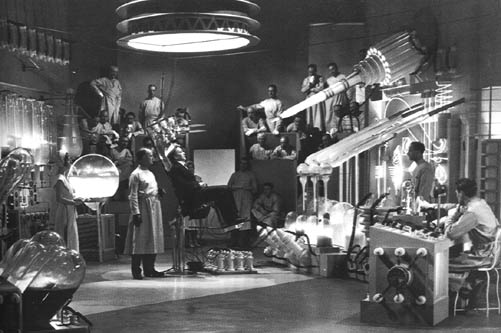
This is momentous news, dear reader, and I have no idea when exactly it finally happened – but the world’s first all singing, all dancing science fiction musical is finally available on DVD.
“Just Imagine” was a landmark film, in which the 1920s and 1930s vision of the future was captured for all time – with amazing miniature sets and rockets, the most famous of which rose out of the prop room to become Flash Gordon’s rocket, in the movie serials – and it is simply not to be missed by anyone who loves the retro future.
It is also a profoundly silly film. Don’t let that stop you.
For years, it’s been impossible to find a commercial tape or disc of this movie, though bootlegs showed up often at eBay.
Just Imagine was an early sound picture – it was released in 1930 – and it features both Maureen O’Sullivan and the vaudeville comic El Brendel. The film takes us (and Brendel) to the astonishing world of 1980 – where we all have flying cars and New York is a multilayered city of public and private transportation, with traffic cops on floating platforms blowing their whistles at us. The sets are fantastic; the rockets are wonderful; and it’s just sort of mind-blowingly naive and silly.
There is (of course!) a trip to Mars, but possibly the best times are to be had here on Earth with its arranged marriages, its food pills, its whiskey pills, and its numerous jokes about Prohibition.
If Metropolis is our serious and socially conscious great-uncle of the retro future, Just Imagine is its jazz age slaphappy cousin. The one we actually want to hang out with.
This is a great day. A tremendous day. It’s good to be here in the future. Now if they’d just release “Madam Satan”. But that’s another story.
This entry was posted on Friday, July 3rd, 2009
and was filed under Reading / Watching / Consuming
There has been 1 Response »