
This thing just makes me happy. “Shake ya Boogie” is an animation by Czarek Kwaśny set to the song by Mocean Worker, AKA Adam Dorn. It’s got a terrific mix of thirties-style animation, dancing wrenches, and retro industrial madness – all with a good old scratchy film chaser.
The music (from the “Cinco de Mowo ” CD) likewise morphs from the present day to the raw, uncontainable jazz of the 20s and 30s. I was glad to discover the CD, which features a guest turn by Herb Alpert.
See the animation here, or go for broke and get the “Cinco de Mowo” CD. Or, you know, do both. You’re unstoppable.
This entry was posted on Monday, October 8th, 2007
and was filed under Computer Graphics, Found on the Web
There have been no responses »
 It’s been quiet in here lately, but for good reason; I’m working on a set of characters for a project, and character work always takes a lot out of me – although this part’s fun. Just don’t ask me about rigging and skinning them. I get nightmares.
This is a space pirate and I have indeed been having a great time working on her. She just needs hair and that rigging-and-skinning process that I mentioned I have issues with.
While I was working on her ray gun I experimented with the beta version of Crazy Bump, an excellent normal map generator. Back in my game days we always used the Nvidia normal map plugin for Photoshop (there wasn’t much else to use) and I wasn’t ever exactly thrilled with what we were able to get out of it.
Crazy Bump, on the other hand, has several tools for analzying your texture maps. It can look for large 3D shapes in the image, and it can find large, medium, or fine levels of detail in it. Once it’s discovered all of those things you’re able to mix their levels together, as well as the overall strength of the normal map, to get just the shapes you’re after. You can blend images together, and you can edit existing normal maps, too. Very nice!
It’s free standing (so it works for any 3D app) and during the beta, it’s free.
This entry was posted on Friday, October 5th, 2007
and was filed under Computer Graphics, Works in Progress
There have been no responses »
Here’s the latest short animation from Michael Sormann’s ongoing “Theme Planet” project. “Bunny Situation” is available in three flavors:
“Theme Planet” is a 3D animated planet that is completely covered by a theme park. One attraction after another is piled high and wide, to cover the whole world’s surface. The story centers on a couple of maintenance workers who live there (the Pig and Elephant characters who appear in this short).
It’s exactly the sort of huge ambitious personal project I most admire even though my own H.A.P.P. is likely to consume me. Or maybe because my own is likely to consume me. Very highly recommended.
This entry was posted on Wednesday, September 19th, 2007
and was filed under Computer Graphics, Found on the Web
There have been no responses »

“Tidy Monster” ia a second-outing CG short film by Tim Marchant. It’s won the 2007 Grand Prix award at the University of Hertfordshire’s ‘Film Day’ event, which shows good taste by them – if by good taste you mean (as I do, at the moment) a taste for absolute freaking insanity and moody, atmospheric dementia.
The audio work and narration is exceptional – the voice is by actor Ben Williams. The film’s an unusual, interesting, and a highy weird experience, which is something that’s always welcome around here. Unless you ask the cat.
Oh – and I noticed that the award was presented by the UK effects house The Mill, who among other things are the force behind the visual effects in the new Doctor Who series.
This entry was posted on Tuesday, September 11th, 2007
and was filed under Computer Graphics, Found on the Web
There have been no responses »
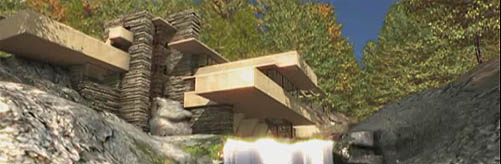
 Cristóbal Vila has modeled and animated a CG version of Frank Lloyd Wright’s Fallingwater. The short film starts with scenes of the famous house growing out of its natural environment and then continues with camera flights around and through the residence. It’s all set to a van Karajan recording of Die Moldau and it makes for a pleasant few minutes of exploration and tribute.
Vila studied in Barcelona and works professionally at his own Etérea Studio. If you enjoy the film you might also like the many images on the site that show its progress and construction.
This entry was posted on Wednesday, September 5th, 2007
and was filed under Computer Graphics, Found on the Web
There have been 2 Responses »
 As if it wasn’t enough that the terminally cute dragons always go home with the babes, this animated short shows us that they can also conquer the forces of darkness in a “Devil Came Down to Georgia” style musical showdown.
Who’s responsible for the madness? That would be Stephen Payne and John Godwin (soundtrack by Tenacious D). They cooked it up at the University of Hertfordshire, a haven for demonic axemen and treacly, guitar-playing dragons.
This entry was posted on Monday, September 3rd, 2007
and was filed under Computer Graphics, Found on the Web
There have been no responses »

“Pest Control” is an animated music video by Peter Leary and a crew of co-conspirators, using Me the Conqueror’s Lo Fi as the setting for an insect rock concert that leads to, well, insurrection. Or something like it.
Really nicely executed in every way. While it’s not new (2005), it does seem to be new to the web. Therefore, go watch it.
This entry was posted on Tuesday, August 28th, 2007
and was filed under Computer Graphics, Found on the Web
There has been 1 Response »

And speaking of the old Amiga days, here’s one of a series of beautiful abstractions by Keith Doyle.
Keith wrote one of the most useful applications I used on the Amiga (“the Director” – a few years before Macromedia fastened on that name). The Director was a version of the BASIC programming language which included powerful extensions for  displaying and manipulating graphics and sound. Keith’s always been interested in both art and music.
Here we see what he’s been up to visually. Many of these images use kaleidoscopic reflections, but others are asymmetrical and nearly representational. Although the scenes they seem to represent are places I haven’t visited since the late seventies. Ahem.
Great stuff!
This entry was posted on Thursday, August 23rd, 2007
and was filed under Computer Graphics
There have been no responses »
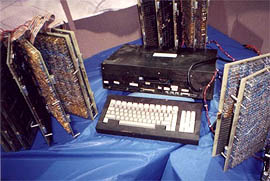 Ars Technica’s History of the Amiga continues with Part 3, in which we finally meet the rest of Amiga Inc.’s team – including R.J. Mical, Carl Sassenrath, Dale Luck, and Dave Needle.
The group is under the gun as they prepare for their computer’s first private showing at CES in 1984. At left we see the prototype of the machine, with each of its three custom chips emulated by enormous breadboard sandwiches.
The operating system is well under way, with Sassenrath’s lean multitasking kernel and Mical’s work on the UI and its interface for developers. But as they near the point where they’ll have an actual product to sell, they’re running out of money. Go forth and reminisce.
This entry was posted on Thursday, August 23rd, 2007
and was filed under Computer Graphics
There have been no responses »
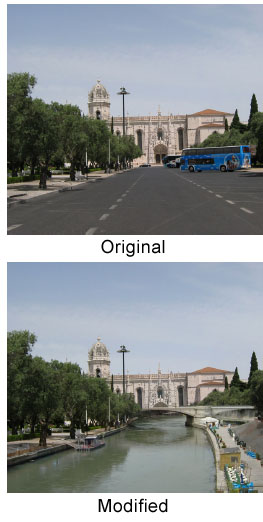 A paper from this year’s SIGGRAPH by James Hays and Alexei Efros (Carnegie Mellon) takes a new approach to digital image “healing” or hole filling. This is a problem faced in many situations, whether it’s restoring a damaged picture, eliminating flaws like a bug on the lens, or just replacing unwanted areas of an image – picture, for example, a plate for a motion picture backdrop in which the makers of a period film want to eliminate modern details.
What makes this technique unusual is that it doesn’t look for other areas in the image for texture and detail to insert. The software that the authors developed uses a database of 2.3 million unique photographs and – without human intervention – looks for semanitic matches for the area that they chose to replace.
No human tagging or hints were used. The program looked over the entire database for broad matches, then looked more carefully for the best fit. When finished (after about an hour on a single CPU, or five minutes on a cluster of fifteen), the authors were presented with several results to choose from. Their paper shows how completely different those results often were, which is one of the most interesting aspects of the algorithm. They also show us examples of bad matches, in which existing methods provided better results than theirs.
Overall the results are impressive, especially considering that the software has to figure out a lot about the images it’s “looking” at in order for this to work. The larger the database, the better it does.

I think that there are some inherent problems with actually using this sort of technique. Their huge database was acquired from Flickr accounts and so there would obviously be copyright issues; also, because some of the solutions include people – even crowds of them – a commercial use could produce photographs of people without model releases, or even any way of knowing who the heck ended up in the picture. And because it’s hard to figure how else you could assemble a library of millions of source photographs, I think that’s a pretty large hurdle to jump. Still, very interesting.
This entry was posted on Monday, August 20th, 2007
and was filed under Computer Graphics
There have been no responses »