Vivian Heller’s The City Beneath Us is a wonderful book from the New York Transit Museum, full of period photographs and information about the construction of the three lines that eventually merged to become the single New York subway system.
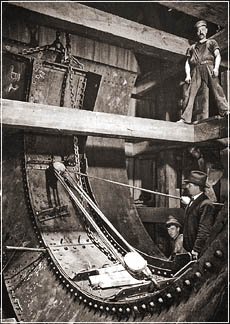 I’m especially interested in the appearance of the tunnels during the 20’s and 30’s, as part of the research for a gigantic personal project of mine. Heller’s book doesn’t disappoint there, but I found that I was captivated by the wealth of historic detail about the struggles to create and maintain the system – first opposed by those who thought it was impossible or ill-advised, and later plagued by the political impossibility of raising the nickel fare – which lasted for nearly 45 years – so that the system could be properly maintained and expanded.
I was amazed to learn that the short test run of a pneumatic subway was constructed secretly (and illegally!) before 1870. That’s how desperate the city was to give its immigrant population some means of getting out of the overcrowded tenements of lower Manhattan – one of the prime motivations behind a public transportation system.
The three lines were built using several different techniques, depending on the composition of the land they were cutting through. While tunnels were driven through rocky sections, a “cut and cover” technique was used wherever possible. Utility lines (already a labyrinth beneath the city) had to be rerouted so that trenches could be cut below the streets and then covered over, the streets being restored above the heads of the workers who then completed the work. Where stone was removed from the tunnels it was moved, with carts, cars, and mules, and crushed so that it could become part of the concrete that formed so much of the tunnel lining. This work was largely done at the turn of the twentieth century and the engineers worked brilliantly within the limits of their technology.
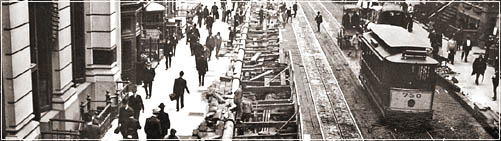
The design itself was so good that even after the collapse of the Twin Towers on 9/11 there was little damage to the tunnels except where they passed closest to the World Trade Center. When those tunnels were rebuilt, the modern engineers made only minor modifications to the hundred year old bracing design that had worked so well.
Likewise the construction of the subway lines that passed underwater used techniques that are very similar to those used in the trans-Bosporus tunnel now being built in Istanbul. Whatever else you can say about the turn of the 20th century, those were days in which builders rightly believed that they could accomplish just about anything.
 Like any public transit system the New York subway has had its rough times, its encounters with bankruptcy, its intrigues, and its rebirths. It’s where Heller’s book deals with Robert Moses that I just had to smile. Moses is a polarizing figure in New York history and he was no friend to public transportation. When I’ve read about Moses’ role in the creation of the 1939 New York Worlds’ Fair, he’s described as a visionary – but because so much of that vision was based on the automobile and its highways he’s very nearly demonized here. He is always a figure who seems larger than life, either way – though from this 21st century vantage I have to lean toward the Transit Museum’s view of him. New York would have been far better served through the improvement and expansion of its public transit.
The text runs for just 81 of the book’s 245 pages – the rest is given over completely to the vintage photographs that introduce us to the workmen and sites that, street by street and borough by borough, gradually knit themselves together into a functioning network that now carries people rapidly and reliably through all of Manhattan and its outlying areas. And while that complete process took decades it’s still true that its original framework – the IRT line – came together in just the first four years of the 20th century, at a time when the city was growing and changing at an unprecedented rate. Mounting and completing such a major project in the middle of that growth and change was – and remains – a staggering achievement.
The City Beneath Us – Building the New York Subways at Amazon.
This entry was posted on Thursday, February 7th, 2008
and was filed under Reading / Watching / Consuming
There have been no responses »
 It looks like Thanksgiving will be the time to stock up on a few cases of Slurm and kick back in the Robolounger, because Amazon is now taking pre-orders for the (first!) Futurama movie on DVD.
Yep – the evil Fox Empire did indeed axe Futurama several years ago – but they’ve been so pleased by its sales on DVD that they’ve contracted for up to four direct to DVD movies from Matt Groening et al.
Each of the direct to DVD movies will also be sliced up into separate episodes for airing on Comedy Central (and – one assumes – elsewhere, as time goes on). This first movie is scheduled for a November 27th release on DVD.
“Bender’s Big Score” sends the crew of Planet Express on a time traveling adventure that involves nudist alien Internet scammers, Leela’s love life, and Fry’s buttocks. It is not to be missed.
This entry was posted on Friday, November 2nd, 2007
and was filed under Reading / Watching / Consuming
There have been no responses »
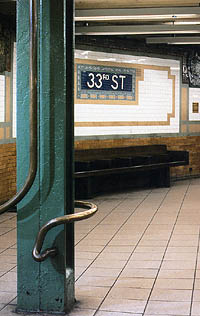 I ran across this book (Subway Style: 100 Years of Architecture & Design in the New York City Subway) while I was looking for reference material for a long term project of mine. I’m especially interested in subway stations up to about 1940, but it’s difficult not to get sidetracked by the wealth of images and information in Garn’s book.
 For example, who knew how interesting the evolution of turnstiles would be? And since these stations have been in constant use for up to a century or more, their layout and design has repeatedly been adapted to new systems for ticket-taking, seating, vending, and just about anything else that happens in a subway station… by design, anyhow. This may make the mainly modern photographs in the book problematic for me, but
  if anything it makes them even more interesting to explore. Still there are quite a lot of period photos and some great graphics used to advertise the subway and its destinations over the years.
I could wish for more examples of mosaic and ceramic work, I guess – we do face the problem today that we can’t take our own reference photographs in the stations – but that’s due to the material I’m looking for. It’s certainly not a failure of the book itself.
At right is a detail I especially like – a modern addition to the Roosevelt Island Station, it uses forms that date back to a 1930 design in order to blend in with the existing fixtures of the IND line.
Here it is. Go forth and browse.
This entry was posted on Thursday, August 9th, 2007
and was filed under Reading / Watching / Consuming
There have been no responses »
I thought I was pretty well acquainted with the major early 20th century industrial designers – like Norman Bel Geddes, Raymond Loewy, and Henry Dreyfuss – until I was talking about them one day with an artist on my (then) team. He’d come from Wisconsin, where he’d studied at Brooks Stevens’ school and later worked at his firm. Stevens himself wasn’t working any more, but he still turned up from time to time. So I did a bit of homework. Which at last led me to this book.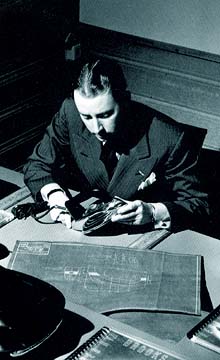
And sure enough, I already knew the man’s work even though I had known nothing about him. Stevens, like those other designers I mentioned, cut his designer’s teeth during the futuristic 1930’s – and like them, he was able to turn his hand to just about anything that was manufactured, from cars to trains to boats to kitchen appliances.
Like Dreyfuss, he was an eminently practical man when it came to product design. But Stevens also had an innate grasp of how people would be affected by the objects he designed. A perfect example of that is the fact that it was Stevens who put a window in a clothes dryer. What had been a featureless cabinet suddenly became animated, hypnotic; the dryers were styled very much like early televisions and in showrooms across the country people just stopped and… watched them. That one decision shows a pointed insight into the way we respond to objects.
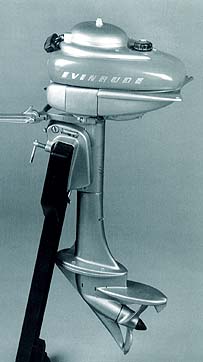 Through his long association with Evinrude, Stevens defined for us what an outboard motor should look like. He often took ungainly machines with jagged, mechanical profiles and streamlined them in casings – just the way designers were encasing steam engines in rocket-shaped, teardrop shells. Likewise he worked for many years for Studebaker, and – not to neglect the the ridiculous – he reinvented Oscar Mayer’s Wienermobile.
Yet one of his best remembered legacies of the 1950’s is his invention of the phrase “planned obsolescence”. He saw this as “instilling in the buyer the desire to own something a little newer, a little better, a little sooner than is necessary.” That’s far from the most sinister application of the phrase – which is to design products so that they will intentionally wear out within a certain timeframe, so that the buyer has no choice but to buy again.
 Even in its more aboveboard meaning there’s a kind of manipulation in the idea that doesn’t sit well with us. But in the past three decades industries have gone far beyond this, with the scheduled introduction of incompatible hardware, data formats, and operating systems, so that we are expected to buy the same content again and again to work on these new devices – especially where the older ones are no longer available. Steven’s phrase and intent seem somehow innocent, at this stage.
This handsome book gives us many examples of Stevens’ designs from every period from the 1930s to the late 1970s, and a good deal of insight into the ideas and client relationships that lay behind those designs.
One of the things that pleases me about these designers is the total world canvas they were able to paint. In the late 20th century industries became more and more specialized. But in the century’s early days it was more than ever possible to be a generalist – in any field, not just in design – and the overall style of the period makes their collective work somehow hang together, like the inevitable result of ongoing progress. It’s a fascinating period to study, and – maybe – to envy, just a little.
This entry was posted on Saturday, July 21st, 2007
and was filed under Reading / Watching / Consuming
There have been 2 Responses »
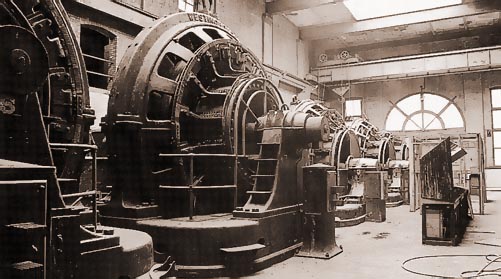
Christopher Payne’s photographs are a sort of urban archaeology that digs down not through sand or sediment, but through the layers of our forgetfulness. Because these remarkable industrial monuments are still there. They’re just ignored.
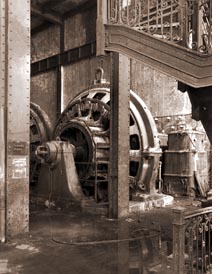 Some of these subway power substations are still in use, rebuilt and equipped with more modern equipment; while many, which make for the most interesting pictures, are abandoned. Those photographs are dreadfully still and fascinating – peeling paint, drifts of debris, and pools of standing water frame the massive power converters and banks of switches and gauges in these innocuous buildings, sprinkled throughout the city.
A power substation received power from one or more powerhouses through massive underground cables. The power converters look like gigantic turbines. Their function was to spin, powered by the incoming AC current, and by spinning generate the DC current that powered the subway.
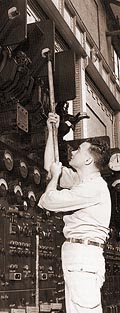 Payne’s book includes period photographs of manned substations, several shots of the exteriors of these buildings, which blend into their setting and are largely ignored, and – best of all, for me – the photographs of these lost installations with their titanic machinery in decay.
The pictures make wonderful reference, which was my reason for getting the book, but they’re beautiful and interesting in their own right. I’m a sucker for early 20th century technology and machinery, of course. But I don’t think you need to be, to be moved by the neglect and decay of these immense machines that once were the embodiment of our progress and hope for the future.
This entry was posted on Wednesday, July 11th, 2007
and was filed under Reading / Watching / Consuming
There have been no responses »
 What if they’d based a film on an H.P. Lovecraft story during his lifetime?
Not only would it have lacked the shlock of “Re-Animator”, but it would have been… silent! In glorious black and white! With thrills, chills, and title cards!
Just like this one, in fact.
What we have here – “Filmed in Mythoscope” – is a re-creation of what that might have been like. Don’t expect expensive (or even inexpensive) CGI here, folks. It’s all filmed with practical effects like hanging miniatures and the action takes place in wonderful, low- to no- budget sets. The most advanced thing going on here, except in the editing, is some judderingly retro stop motion animation.
The actors do a creditable job and the film, which weighs in at a brief 72 minutes, just approaches its own low budget nature – with quivering tentacles – and absorbs it, makes it its own, as a feature of its period style. It’s a great example of turning necessity into a virtue.
And should you buy or rent it, don’t fail to watch the making-of material in the bonus features. Once you know that the South Atlantic and the ruins of R’Lyeh were filmed in somebody’s back yard, you’ll be about ready to give it a go yourself.
It’s a fine adaptation, a curious object, and a lot of fun to watch. And should you speak a language other than English – even I think, Finnish – you can watch in your own mother tongue. The fact that all the dialogue’s on title cards meant that the makers could translate the movie into an eldritch and unspeakable variety of languages. Which, compelled by the will of the Old Ones, they did. Nifty!
This entry was posted on Wednesday, July 4th, 2007
and was filed under Reading / Watching / Consuming
There have been no responses »
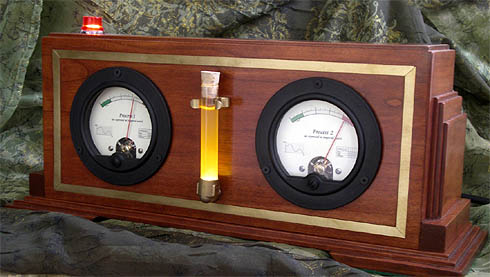
I’m always on the lookout for new additions to the Secret Laboratory, whether it’s sharks for the moat, or… in this case… nifty analog gauges to tell me whether space pirates have breached my defenses, or whether my coffee’s getting cold. (As if!)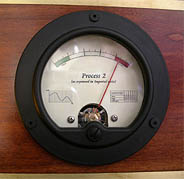
The Device Patented Process Indicating Apparatus promises to be all this, and more. Though I think it’s likelier to tell me how hard my cpu’s working.
The Device is a handsome, wood and brass built unit that offers two analog gauges and an indicator light; it’s a programmable, um, Device, and has a USB port so that it can talk to your computer. The custom software allows you to tell the unit what it should be monitoring (like my CPU usage). Though the web site mentions both “Electrotherapeutic Shock Intensity” and “Ebay Auction Status”, which, um, indicates just how versatile a Device it is. Whillikers!
Just wish it was available already – like those Weta rayguns!
[tags]computers,hardware,usb,gizmo,widget,apparatus,retro,analog,device,mad scientist[/tags]
This entry was posted on Wednesday, July 4th, 2007
and was filed under Found on the Web, Reading / Watching / Consuming
There have been no responses »