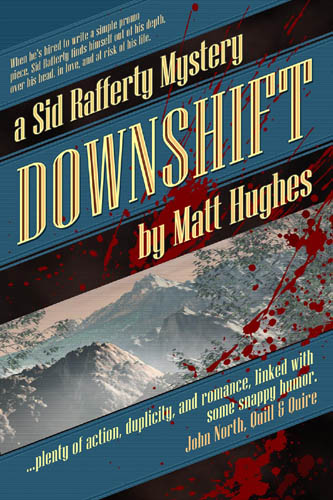
Over at the Archonate, where Matthew Hughes can be found, you can now get his collection 9 Tales of Raffalon as an eBook for the introductory price of just 99¢.
Seven of these stories have appeared previously in The Magazine of Fantasy and Science Fiction; one (The Inn of the Seven Blessings) was written for the Gardner Dozois/George R. R. Martin anthology Rogues; and one (the novelette Sternutative Sortilege) is seen here for the first time.
It’s a surprisingly long collection, as large as a novel, and since I’m the guy who just formatted it you can believe that I know what I’m talking about. I also got to do the cover for this one – you can see it here.
Here’s the book’s description:
In an age of wizards and walled cities, Raffalon is a journeyman member of the Ancient and Honorable Guild of Purloiners and Purveyors. In other words, a thief.
His skills allow him to scale walls, tickle locks, defeat magical wards. He lifts treasures and trinkets, and spends the proceeds on ale and sausages in taverns where a wise thief sits with his back to the wall.
But somehow things often go the way they shouldn’t and then Raffalon has to rely upon his wits and a well calibrated sense of daring.
Here are nine tales that take our enterprising thief into the Underworld and Overworld, and pit him against prideful thaumaturges, grasping magnates, crooked guild masters, ghosts, spies, ogres, and a talented amateur assassin.
Like several of Hughes’ recent works this one takes place after the Universe has completed its transformation from a realm of reason into one ruled by Sympathetic Association – which we might know better as “magic” – and which, in that state, bears a strong resemblance to Jack Vance’s Dying Earth.
As always with Hughes, highly recommended. Go get one for less than a dollar!
This entry was posted on Friday, April 21st, 2017
and was filed under Found on the Web, Works in Progress
There have been no responses »

AbeBooks is a huge marketplace of independent used booksellers, with each one posting their own catalog of titles into a single massive online bookstore. Now and then they curate special collections like this one; the curated collections may be a little easier to navigate than the wide-open search that you usually use at the site.
The Pulp magazines collection we’re looking at today offers a pretty wide selection of magazines from the 1930’s on, all with their vibrant (if faded) covers, all in the original format, and often available at tempting prices. You can expect a range of prices because each of these sellers may value their stock a little differently. And as always with vintage publications there are some good copies along with some others that are showing their age.

It’s a great collection that has many examples from Amazing Stories and Astounding but doesn’t neglect their less iconic rivals, like Planet Stories or Super Science Stories. And, you know, All This Could Be Yours.
This entry was posted on Tuesday, October 25th, 2016
and was filed under Found on the Web
There have been no responses »
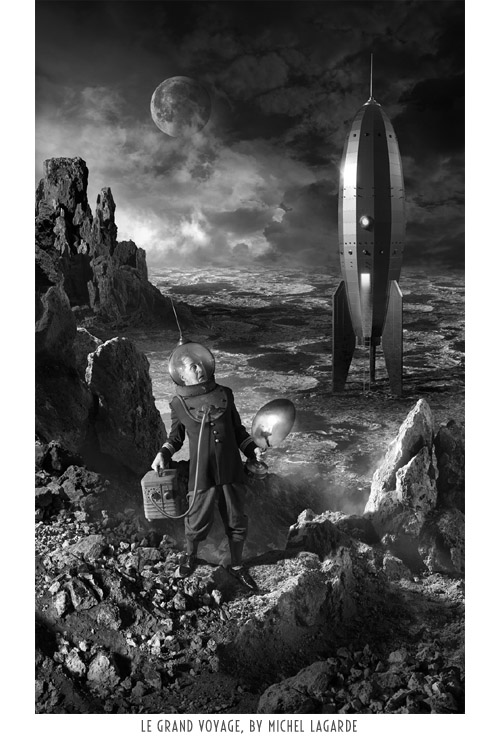
Each one of these meticulously composed, hyperreal photographs by Michel Lagarde is an elaborate production, and I love them.
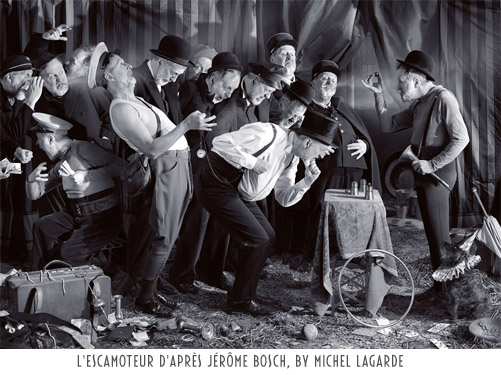
Lagarde builds these pictures from the ground up with a combination of techniques that include 3D modeling, miniatures, and model photography, all combined with an impossible sharpness and clarity into weird, engaging images that seem as though they could only come from France, like the films of Marc Caro and Jean-Pierre Jeunet.
In the example below, see how the same models appear – even in the same costumes – more than once. The stillness of the stagy composition contrasts with the implied motion of the characters in a bizarre, brain-bending view of motion and motionlessness, all in a single frozen moment.
You can see these photographs in two galleries at Lagarde’s web site, here and here. It’s possible to buy prints from the artist; unfortunately it looks as though his two hardcover collections are out of print.
But in addition to the galleries there are a couple of behind the scenes pages at the site. They’re fascinating. You can see how Lagarde works out his composition with a variety of tools and then builds the parts he needs to create the picture. The number of layers? Up to a hundred, and possibly even more.
The whole site is well worth a visit. Just be ready to lose some time there.

This entry was posted on Tuesday, October 11th, 2016
and was filed under Found on the Web
There has been 1 Response »

This is Sugar Space, by Russian illustrator George Redreev, and it’s just one of a long series of illustrations he’s posted at CG Society and at Artstation.
The CG Society page has many more pictures, but at Artstation’s page for this image you can see a large animated GIF that chronicles the picture’s progress from a rough thumbnail sketch to the final, full color painting. So both are worth a look.
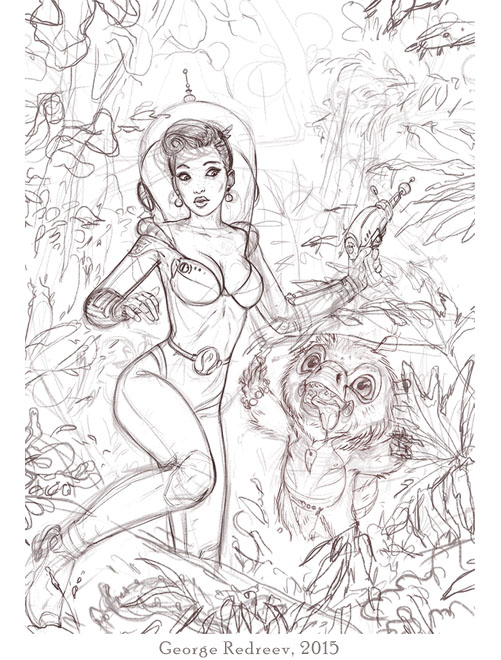
This picture has such a playful treatment that it’s possible to overlook the pretty obvious objectification that’s at work here. (Well, it was possible for me, anyhow; your mileage may vary.) I look at it in the same way that I delight in the joy and playfulness of Dave Stevens’ pin-ups. The takeaway seems to be affection, and that may be what makes the difference.
His entire galleries show a lot of other work, much of it aimed at childrens’ illustration; one of my favorites appears below. But of course it was Sugar Space’s cheerful retro-futurism that was pretty much up my street. Provided that my street is lost somewhere in an alien jungle, I mean.

This entry was posted on Monday, July 4th, 2016
and was filed under Found on the Web
There have been no responses »

Rory Björkman’s The Journey is a beautifully lit, modeled and textured image of a crusty old fellow on his crusty old three-wheeler. You can see the full image and loads of details, color tests, and other preliminary versions here.
It’s all worth looking at, from the many versions of the trike’s grille through the test renders of the helmet, the baggage, and many other elements from the picture. It’s really wonderful work, all of it.

In fact, you shouldn’t stop there: you can see a much larger gallery of Björkman’s work on this page, where I especially recommend Sky Machine No. 47. Nice!

This entry was posted on Monday, June 27th, 2016
and was filed under Found on the Web
There has been 1 Response »

I came for the chairs; I stayed for the scooters.
Almost everything is scooters at Barcelona’s Bel & Bel Studio where old body parts from Vespas, Volkswagens, and other vehicles are repurposed into furniture and other works. They even do full restorations on vintage Vespas… when they’re not looting them for their shiny bits.
It was the fanciful office chairs that drew me in. Mind you, I’m awfully fond of the tired old chair I use here in the Secret Laboratory. But I flirted briefly with these streamlined beauties before I assured my chair that no, no, I would be faithful.

You can see why I was tempted.
But then I scrolled down to the self-balancing scooters, which by any other trademark would be called Segways… and suddenly I had a vision of myself zipping down the street in the dorkiest way possible, goggled and scarved, and I figured I was home.
 You get the idea. If you’re going to look ridiculous, do it with streamlined style. In a perfect world, which at the moment would be a world where I didn’t need any exercise, you’d find me rolling off on one of these to the library, or to the grocery store, or down to the harbor, pretty much any day at all. With a big stupid grin on my face and that mounting sense of guilt and dread I get when I’m not working.
Anyway, do yourself a favor by dropping by the Bel & Bel web site where you can dream a little, if only for a few minutes. They’ve got loads of interesting furniture conversions and gadgets, as well as making-of videos. There’s plenty to keep you occupied.

This entry was posted on Monday, June 20th, 2016
and was filed under Found on the Web
There have been no responses »
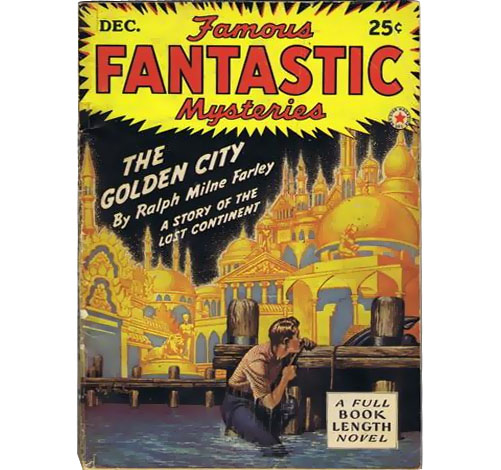

I just ran across this curated collection of pulp magazines and reprints over at AbeBooks… a web site that’s like all my childhood’s used bookstores lumped together, but without the dust.
I kind of miss the dust.
But apart from that, there are all sorts of old pulps and paperback reprints over there. As you may imagine, I’m most interested in what we see here (Pulp-O-Mizer fodder!) but there are a great many Westerns and thrillers along with more reprints of Doc Savage and The Shadow than most of us really want to look at.
It may not be Something For Everyone, but it’s a Lot of Things For a Lot of People. You may be one of them.

This entry was posted on Tuesday, May 17th, 2016
and was filed under Found on the Web
There have been no responses »
Over at his Archonate blog, Matthew Hughes has posted an announcement for the eBook and audiobook editions of his late-90’s mystery novel Downshift. There’s a comedy of errors about its first publication and the circumstances under which he wrote its sequel, Old Growth, which will also soon be republished under his own brand.
Then, three months before Downshift came out, my editor departed for another publisher– a nonfiction house, so she couldn’t take me with her. Immediately my print run was cut, my tiny promotional budget went to another book, and the marketing effort, except for library sales, was a few mouse-sized squeaks. Months later, when I asked if there were remaindered copies I could buy, I was told, “Nope, as the returns came in we sent them straight to the pulper.”
Not so comedic, maybe. But then again, I think I remember one definition of comedy as a story that relates events to their human sufferer, while tragedy connects events to their hidden cause.
A paperback edition is forthcoming, which I know because (as usual) I laid out the book in mobi, ePub, PDF and print formats. This time I also did the cover, a nice match to the Old Growth cover that will also be coming along soon.
This entry was posted on Sunday, May 15th, 2016
and was filed under Found on the Web, Works in Progress
There have been no responses »

With stories (so far) by David Gerrold, Mike Resnick, Gini Koch, Jody Lynn Nye, Tim Pratt, Esther Friesner, Shaenon K. Garrity, and Laura Resnick, Unidentified Funny Objects #5 aims to continue UFO Publishing’s hilarious attempt at world domination – and so will unleash an Unstoppable Humor Machine in November, with a little help from you.
The Kickstarter project offers rewards that range from eBooks of previous humor anthologies ($5) through a paperback copy of UFO #5 ($20) and then rears up in its gel-filled tank to snap at unsuspecting lab assistants with a horrifying (though funny) head at the end of its colorful (though repulsive) neck with additional rewards that include original art and full sets of UFO Publishing’s eleven volumes of hilarity. And then there’s other stuff that wouldn’t even fit into a sentence that went on as long as that last one.
My rediscovery of humorous science fiction started with Henry Kuttner’s Robots Have No Tails and it isn’t done yet with the stories of Fredric Brown, only because there are so many of them. So I’m really happy to see people continuing that tradition with all-new stories in this crowdfunded series of anthologies. Be the first on your block to own one!
This entry was posted on Saturday, March 5th, 2016
and was filed under Found on the Web
There have been no responses »

The Golden Age has posted a small collection of science fiction book covers and endpapers by Alex Schomburg (Alejandro Schomburg y Rosa), best remembered for these and for his extensive work for Timely Comics in the 1940’s. Timely would later become Marvel Comics.
Born in Puerto Rico, he came to New York in the 1920’s and began his career in illustration in the decade that followed.
Schomburg was a Hugo Award nominee in 1962 and went on to collect many other awards during the 1980’s before finally receiving a Lifetime Achievement Award from the 47th World Science Fiction Convention in 1989.
Of the pictures in this Golden Age collection I think I’m most fond of the endapaper design above. But you can see many other pieces (with an emphasis on his work for comics) at the Alex Schomburg Estate web site.

This entry was posted on Thursday, February 11th, 2016
and was filed under Found on the Web
There have been no responses »