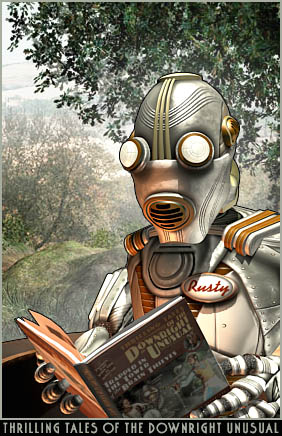
 Sommer Leigh has written a pretty thorough description of the retro futurist genres that (mostly) end in the suffix "punk".
I’ve said before that I’m not all that crazy about labels of this kind, and it’s partly because apart from the first of these – cyberpunk – the punk suffix is completely meaningless.
In William Gibson’s Neuromancer and in at least its first descendants, "punk" really did belong in the name. The technological marvels of these futures were not there to benefit people. They were there to cement the power of large corporations and organizations. The fact that a disenfranchised few on society’s fringes were able to subvert those technologies to their own ends is what made them punks, in the punk rock sense. They were standing on its head the mechanism of power and making something personal and subversive out of it.
But then the word became popular, and shortly afterward it became meaningless, as we see in all the labels that have followed.
Leigh touches on this in her description of steampunk, which is nice to see. Heck, it’s always nice to see people thinking about the meanings of the words they use.
Apart from my own crotchety observations, then, Sommer Leigh has come up with short form descriptions of what each of these labels gets stuck on which should be useful to anybody who wants to use them. (Did I say I was done being crotchety? Oh well. And get off my lawn, there, you kids!)
Consider it a field guide to spotting these words when they’re thrown around in the wild. There are some nice examples cited except, oddly, for the one label I rather like. That’s "Raygun Gothic". Why do I forgive that particular label? First off, there’s no meaningless suffix – what a relief! But despite that, if you take a good look at it "Raygun Gothic" doesn’t seem to mean much, either. It’s just such a… pretty phrase, I guess, and sort of evocative, so I find myself smiling at it even though it, too, seems to be playing on my lawn.
This entry was posted on Friday, April 8th, 2011
and was filed under Can't Stop Thinking, Found on the Web
There have been 4 Responses »
 Sometimes, when I see the increasingly litigious ways we deal with one another, I think about the things we’ve lost. Oh, I don’t mean disputes over property lines or breach of contract or any of that. I’m thinking about the way we now use law to set our personal boundaries and criminalize bad behavior.
It’s not that I don’t despise things like sexual harassment. In fact that’s one I especially dislike. Sexual harassment is the sort of thing that makes a thinking man angry. I mean, a few overgrown infants make the rest of us look pretty bad by association, just because we share the same kind of plumbing.
But as we’ve relied more and more on labelling behavior, and on laws to regulate it once it’s labelled, and on punishments for it once it’s regulated, we’ve lost some of the skills that people need just to deal with each other in groups. Skills that we actually used to have.
A lot of bad behavior is more unfortunate than it is criminal. Once upon a time we’d have dealt with it through deflection… or by hauling the offender out behind the tobacconist’s and knocking out one of his teeth.
Case in point: stalking. Once upon a time some forms of stalking were not only permitted. They were necessary. I wouldn’t be here typing this if my grandfather hadn’t stalked my grandmother. And there wasn’t a creepy thing about it.
My grandfather – who, later in life, appeared in the terrifying photograph above – first saw my grandmother on the Vaudeville stage. She would have been about sixteen at the time, right about the time her photo below was taken.
This was the musical comedy act of Noodles and Elsie Fagan. My grandmother Blanche and her sister were each part of their parents’ act. Family legend has it that Grandmother even managed the act from the age of eleven because everyone agreed she was the most sensible one of the bunch.
So when Reuben Smith saw her on that stage she’d have been singing, lit romantically by the stage lights. And that did him in. The moment he saw her he decided that this was the girl for him.
 But what to do? In that day and age you wouldn’t get anywhere by approaching a young woman and introducing yourself. You’d do more harm than good. An action that forward was an implied insult: by acting improperly, you’d be suggesting that she was improper and that, as they say, would be Game Over. Out behind the tobacconist’s for some quick dental surgery, bub.
One of the interesting things about what my grandfather did do was that it’s closely paralleled in Robert A. Heinlein’s Time Enough For Love, in an episode set at about the same time. Lazarus Long, in that story, travels back in time to meet his own family. And he does just what my grandfather decided to do on the night he saw my grandmother on Vaudeville and followed her all the way from the stage door to her front door. In the dark of night. Stealthily, I bet.
Grandfather started to hang out in her neighborhood. He started shopping there; he ate his meals in the neighborhood restaurants; he hung out there long enough to make some friends, and once he was a fixture in the neighborhood, someone introduced him to my grandmother. The rest, if not history, is my history. And – probably because of the way things turned out – even that bit of stalking under the streetlights doesn’t seem sinister. It seems charming.
I’m fascinated by the fact that Heinlein had his character adopt the same strategy because it suggests that my grandfather wasn’t the only one. I really wonder if someone Heinlein knew in the 1920’s hadn’t told him a family story a lot like mine.
Chances are that if my grandfather tried this clever plan today he’d end up in jail, and as a result there would be no me to tell his story.
Now one reaction you might have to this tale is that in a repressed and rigid society people are forced to deceive and scheme in order to lead a normal life. I think that’s absolutely true. But after half a century in a less repressed and rigid society I haven’t noticed that people have given up deception and scheming. So, I say, phooey.
And when I think about those stiffer, more formal days I also think that when we hand over our personal relationships – even the unpleasant ones – to the law… well, we’re formalizing those things in a different, impersonal way. Society hasn’t abandoned its rules and manners. It’s just delegated them. How weird is that?
[tags]stalking, society, mating rituals, law, robert a. heinlein, time enough for love[/tags]
This entry was posted on Thursday, May 20th, 2010
and was filed under Can't Stop Thinking
There has been 1 Response »
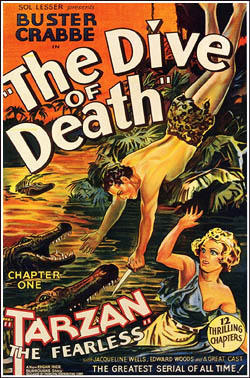 We have to thank Mister Doortree of Golden Age Comic Book Stories for this image (thanks, Mister Doortree!), which has reminded me of something odd from the past.
Back in 1977 I moved from Southern California to a great, small beach town halfway up the coast. Wonderful place… but I’m not going to say where, exactly, for reasons that may become clear.
For the first little while that I lived there, every time someone local found out that I was new in town they would always tell me: "Don’t go to Happy Jack’s!" I’m serious. This happened every time.
The bar called Happy Jack’s, it turns out, was The Dive of Death.
The only thing that anyone ever said… specifically… about why I should not go to Happy Jack’s was, I kid you not, that they sold knives at the bar. Because people in the bar kept finding out that they really needed a knife, apparently. All of a sudden.
The fact that virtually everyone told me not to go in there was good enough for me. A few years earlier or later, and maybe I’d have made a beeline for Happy Jack’s. But just then, I decided to take their word for it.
And after awhile, well, I was a local. And without even thinking about it, when someone new showed up I’d tell them "Don’t go to Happy Jack’s". After a couple of years I started to wonder why I was telling them that. I’m not sure if it stopped me, though. This says something about the way people behave in groups. Most of the things you can say about how we behave in groups are not very good things. This could be an example.
So eventually I moved away and had adventures, and mostly I forgot all about Happy Jack’s. But years later I came back to spend the Christmas holidays in the old town. And I found myself walking down the street right past the open door of Happy Jack’s. I had never seen that door standing open in all the time I lived there.
It was quiet in there. They had a lot of Christmas decorations up. I’m pretty sure there were little Santas. And it looked like a peaceable, quiet sort of place to drop in for a drink.
It seemed to me that there’d been a change of management in the fifteen years I’d been away and I was sort of sad to see it tamed. If it had remained a little dangerous it would have been a lot more interesting. I didn’t go in.
I’m still not sure if that was a mistake. And I’m not sure that it wasn’t just force of habit, either.
But then there’s this: what if Happy Jack’s had never been a dangerous bar where they sold knives to people who suddenly needed them? What if the whole thing had been wrong… and I’d been perpetuating that when I chimed in to warn off the new folks in town?
I find that I prefer to believe that it was all true. But then, that’s what we usually prefer, isn’t it?
[tags]happy jack’s, the dive of death[/tags]
This entry was posted on Sunday, March 7th, 2010
and was filed under Can't Stop Thinking
There have been 2 Responses »
E-Readers (Neat!) and E-Books (Not!)
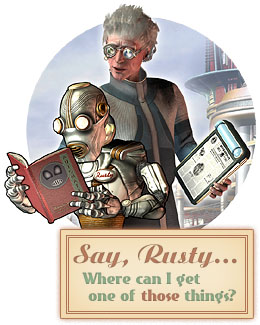 I love the idea of a reading slate, an e-reader, a tablet. I love books, after all, and no computer can match their portability or ease of use. And there’s that retro-futuristic quality about them – though honestly, even modern futurism likes the gadgets – that makes me feel right at home with an imaginary one in my hand.
The problem is that we should not want the ones that are here and coming to market. They’re loaded with problems for those of us who would like to use them. Their functions and their limitations are heavily skewed toward benefits to their manufacturers’ limited and incompatible retail schemes. So much so, in fact, that as sexy as you may think that iPad demo was, or as pleased as you are to see Neil Gaiman exulting over the Kindle, these gadgets are going to lead their buyers down a dark and twisty path that leads to that place where media go to die.
A book is a simple object, which is not to say it’s a limited one. It’s portable knowledge. It – importantly – is an object that can outlive both its author and its reader. All its contents are present at once, and one can skim it or hone in on a particular page as quickly as one’s eyes and fingers can move. It can be given to a friend; it can be loaned for a short time; it can be sold or traded. It can be borrowed from a library. It can be left on a dusty shelf for a couple of decades and then picked up and read again. Someday, long after its author wrote it, it will pass into the public domain and can then be reprinted for next to nothing.
E-books, like books, are portable knowledge. But they’re very bad at everything else in that list.
(more…)
This entry was posted on Tuesday, February 2nd, 2010
and was filed under Can't Stop Thinking
There have been 5 Responses »
Once upon a time in a career far, far away, my then co-conspirator Michal Todorovic and I were working in game development. Our publisher was Electronic Arts – which, even then, was an eight hundred pound gorilla in a stylish suit.
EA had started out as a company that went out of its way to honor its creators. It practically rolled in its creators. Creator photos and bios appeared inside every one of its unique, album-shaped packages. EA was near and dear to the hearts of the gaming public and of developers, to boot, who in those days were practically two sides of the same coin.
There was a time when a couple of people could walk into EA and walk out with a contract. I know. It happened to us. Of course when we got back to the hotel we realized that the contract they’d given us was a work-for-hire contract and Job One was to tear that puppy up and tell them to try again.
Because EA was changing, and in fact had changed, by the early 1990s. They were doing less and less internal development. They were doing more and more producing of titles that were developed at the little startups who still thought they might survive in what was rapidly becoming a very big business.
And as a result, the people at EA were changing. You didn’t see as many people who had actually made games. You saw more and more who had only worked in game production, which isn’t the same thing. So while we didn’t know it, this was the beginning of that trend in which game testers would by stages be promoted to game producers, ensuring that no one who oversaw game projects would have any experience in making the things. And that the people who would give you valuable feedback on a game’s design had never designed a game. But they thought they had: they were Electronic Arts, weren’t they? And they never realized that they weren’t the same Electronic Arts that had done the wonderful things they thought they’d done.
None of this was really obvious at the time. There was just this puzzling state in which it was clear that something was different.
In the course of hammering out a real contract we needed to write documentation that described what the project was and how we’d overcome its challenges. Perfectly reasonable if you wanted the company’s money, which we did. I worked on the design documents, and Mike worked on the technical documents, and everything – we thought – was going pretty smoothly.
We’d been working on our game (The Labyrinth of Time) for about a year already, so we had a pretty good idea what it was, how it worked, and what we still needed to do. I’d created a complete game design document already. That included several sections of the game that could be deleted, if necessary, and the steps we’d need to take to patch the holes those sections left.
Then the most important of the technical documents came back from its reviewer. Well, okay: what did we need to add, or do differently? He didn’t know. He hadn’t read it. His complete review was: "It feels light. There’s not enough there."
Mike wasn’t sure what to do about that – especially since what he was writing about already existed, and, well, he’d documented it. So since this was a matter of presentation, he asked for my advice.
We looked over the document. We increased the font size. We increased the spacing between the lines. We added one paragraph. We printed it out on thicker paper. The new document spanned more pages and each of those pages weighed more than the old ones had.
When the technical director got the new version, he said "Yes, this looks much more complete."
I don’t think we acted dishonestly. The document had been rejected, unread, on the grounds that it "felt light". So to fix the problem we made the document heavier. Everyone wins!
But the story didn’t end there. The document was kicked back again because of one required section in which we had to describe the problems we had not anticipated, and then explain how we would overcome those problems.
Let’s review that, shall we?
We had to describe the problems we had not anticipated. The problems that, by definition, we did not know were there. And then explain how we would solve those problems. Of which we were – again, by definition – completely ignorant.
I’m not sure how we described the things we did not know about, but our plan for overcoming those obstacles was:
We will crush our enemies, drive them before us, and hear the lamentation of their women.
Problem solved: that version of the document was accepted.
This entry was posted on Thursday, January 28th, 2010
and was filed under Can't Stop Thinking
There have been no responses »
Over the years the Universe has now and then slapped me upside the head with a reminder that the world is a strange and wonderful place. Because, you know, it is. And it’s easy for us to forget that, isn’t it? So although I’ve never made a point of thanking the Universe for those little revelations, well, here I go: thanks, Universe!
In every decade since the 1970’s I’ve told myself that the 1970’s did not count. I was a teenager then. As far as I’m concerned that decade was pretty much a warm-up exercise. So if you’ll agree with me about that – that what happened in the 70’s stays in the 70’s – I’ll tell you a story.
(more…)
This entry was posted on Sunday, January 24th, 2010
and was filed under Can't Stop Thinking
There has been 1 Response »
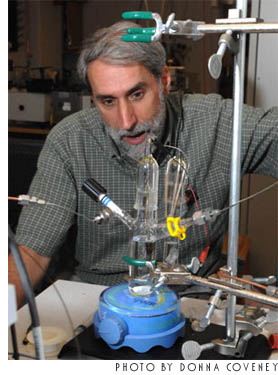 Back in May of 1935, Charles F. Kettering of General Motors told Modern Mechanix & Inventions magazine that if we could only unlock the secrets of photosynthesis and harness them, we’d have found the way to create almost limitless, inexpensive energy.
Researchers at MIT seem to have cracked that nut in a way they hope will turn each of our homes into its own power station – and filling station – with a process that can cheaply and effectively store electricity from solar (or other) sources using common carbon-free materials at room temperature.
Storing and transmitting energy is a lot more difficult than you’d suppose. There are inevitable losses as energy passes through power lines. That’s why the extensive wind farms being built these days provide regional, not national, power. In fact, about a gazillion years ago when I worked at the Diablo Canyon nuclear power plant on California’s central coast, that plant was linked to an underground hydroelectric plant. In off hours the nuclear plant’s energy was used to pump the subterrainean reservoir uphill so that in peak times the water could rush downhill and power turbines that supplemented the nuclear plant’s output. Very clever, really, but there were still substantial losses in energy because of friction.
And storing solar power for later use at night is one of the problems that continue to face the solar power industry.
This new process developed at MIT – due in part to the funding of a ten million dollar grant from the Chesonis Foundation – is a very simple technique that uses electrical current to separate oxygen and hydrogen in gaseous form, later to be recombined to produce power or charge fuel cells. The result could be the near complete decentralization of power. Each home would become its own solar power plant and filling station for the fuel cells we’ll need to power our electric cars. It’s the sort of energy system you’d expect to need in outer space – but you’d be using it at home.
In practice, I’d expect that homes would remain on the grid but that demand from the central power stations would drop tremendously as these homes began to generate their own power. In fact the excess power could even be sold back to the utilities. This process is intended to make solar power more effective but it only requires an electrical current to work – so it could be used with any electric sources, including wind farms, which also have a greater or lesser output depending on the conditions outside.
And couldn’t this same process be used in a centralized way to produce the still-expensive hydrogen fuel cells that remain a barrier to fully electric cars?
This entry was posted on Tuesday, August 5th, 2008
and was filed under Can't Stop Thinking, Found on the Web
There have been no responses »
Every now and then, Cafepress makes a fundamental change in its terms of service for shopkeepers, and almost without exception there’s a huge backlash by shopkeepers who believe that this new change is going to have a severe impact on their income. Often, they’re right. Even when they’re wrong it’s annoying that a party with which you do business can redefine the terms of your agreement with them at any time, while you can’t – ever – do the same thing. Or anything like it.
In fact (especially over the past two years) Cafepress has been nickel and diming away at its shopkeeper/designers in what’s probably been meant as an effort to maximize profits. Often, by the looks of it, this to make the company’s balance sheets continue to escalate quarter by quarter in a way that will be sweet music to to the ears of investors in the event of a probable IPO. Anyone who’s chased that particular dragon knows that once you start it becomes more and more difficult to pull off the same scale of growth in each quarter. It only gets harder if you do go public.
From the shopkeepers’ perspective, though, it looks as though the company is finding every way it can to monetize not the customers who buy all this merchandise, but the shopkeepers who create it. That impression was reinforced a few months ago when very large Cafepress stores (those with more than 500 sections) were abolished, though existing shops were grandfathered in. Shopkeepers who wanted to bloat their ventures with more merchandise than that were going to have to establish additional premium shops, for additional monthly fees.
This month’s brouhaha is all about the Cafepress volume bonus, a plan through which those shops with a high sales volume are rewarded by incremental bonuses: the more you sell, the larger your bonus. The volume sales bonus has often been named by CP shopkeepers as the reason they would stay with Cafepress rather than moving to a competitor.
Back in 2002, when I started my first Cafepress shop, it was understood that this bonus was a reward for the promotion a shopkeeper did to increase sales at his or her shop. And as little as I think of the company’s maneuvers over the past couple of years I think that the new program is better suited to that end. Not that I don’t think it’s seriously flawed – but the flaws I see are of another kind entirely.
(more…)
This entry was posted on Thursday, July 24th, 2008
and was filed under Can't Stop Thinking, Print On Demand
There have been 8 Responses »
 My recent banner ads have worked absolute wonders for me – especially the ones for the Retropolis Transit Authority, my retro-futuristic T-Shirt site.
On a good day, or in a good week, I can watch the traffic there snowball into a regular avalanche as those folks who’ve found me through the banners post about it in forums, at their blogs, and so on. Some of those sites are very popular – or a popular blogger may find one of those first generation posts, and it can build from there. Well. Sometimes. It’s not like that’s every day, or every week. But here are some highlights:
io9 Blog | Boing Boing Gadgets | AMCTV’s Sci Fi Scanner | Schlock Mercenary | Pharyngula | Livejournal’s Anachrotech Group | Steampunk Librarian
One thing that’s surprised me about some of my recent linkage, though, is the number of people who’ve described my work as Steampunk. Because although I’m not one to snap on my brass goggles and to holster my Aetheric Odds Equalizer before I go out, I’m pretty well aware that Steampunk is all about the retro future of the Victorian and Edwardian eras, which means it’s not really what I do. Mind you, I like the style well enough, and I have a couple of things in the Idea Closet that would certainly be steamy, but they’re digressions, for me. My Future That Never Was is really all about the 1920s and 1930s and our ideas, back then, of what Tomorrow might bring.
The inestimable Molly Porkshanks has brought another word to my attention – dieselpunk.
Now that, with its allusion to early twentieth century technology, sounds nearer the mark; but even there it’s much more evocative of Sky Captain and the World of Tomorrow than it is of what I’m up to. My rockets and robots aren’t diesel powered and my retro future isn’t, either.
And, frankly, although I was all over the genre of “Cyberpunk” as soon as Neuromancer hit the shelves, the subsequent *punks have sort of made my eyes glaze over. There’s clockpunk, for example, and biopunk, dieselpunk, and even – I guess predictably – postcyberpunk.
There’s not a lot of punk in any of them, of course. The “punk” suffix has lost its meaning. At one game company where I worked, the owners’ pet project was a supposedly cyberpunk game in which they’d forgotten to put the punk in. It wasn’t anything more than a sort of direct-to-video science fiction idea. The word had lost its meaning.
 So the names, styles, and labels aren’t really my own cup of tea. I’m always pleased when people like what I do and with a name like mine, you’ll understand that I long ago decided not to bother very much about names and their derivatives. So if people who like steampunk or dieselpunk also like what I do, I’m thrilled; and even if they attach a favorite label – rightly or wrongly – to it, I don’t suppose I mind very much, even if I’m not quite sure why they do it, and even though I suspect that they’re watering down their own terminology when they do it. So what the heck; I’m even using dieselpunk, at least, in tags on my web sites.
Now on the other hand, I’ve recently been reading Patrick O’Brian’s excellent seafaring novels about the Napoleonic period and I have this idea that something along those lines with sky pirates and fleets of airships would just be the bee’s knees. So, somebody, go write them!
Odds are they’ll be something like Steampunk, or maybe Sailpunk. And I’ll certainly read them, even though what I’m up to is something else.
This entry was posted on Monday, June 2nd, 2008
and was filed under Can't Stop Thinking
There have been 3 Responses »

Comic Book Resources reports what could be wonderful news, or terrible news, depending on how it works out. The John F. Dille Trust has reached an agreement with Dynamite Entertainment to revive the Buck Rogers comics as a comic book series with many merchandising tie-ins. No writers or artists are yet attached to the project except that covers will be provided by the very able hands of Alex Ross and John Cassaday.
When I looked into Buck about ten years ago I thought that Disney had sewn up most of the rights; I have to assume that what I was looking at were film and television rights, though, or that those agreements have since expired.
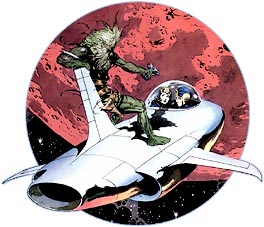 Buck Rogers was a first in many ways. His adventures began as a work of short fiction and then transmogrified into a successful comic strip that ran for almost four decades. Written by Phil Nowlan and originally drawn by Dick Calkins, the series was ghosted (at least on the art side) many times over its reign. On the left we see one of Frank Frazetta’s contributions from Famous Funnies in the 1950’s.
Buck paved the way for science fiction heroes in both comics and radio . He didn’t have the same success in movie serials as did the me-too character Flash Gordon, but for my money the Buck Serials were a good deal more fun. But backpedal to the early days of the comic strip for a moment, because one of the most astonishing things about Buck’s popularity in those days of the late twenties and the early thirties was that he invented merchandising.
(more…)
This entry was posted on Thursday, March 13th, 2008
and was filed under Can't Stop Thinking, Found on the Web
There have been 5 Responses »